Thanks for dropping by. After three great years here at .blogspot we have picked up and moved to a new site. Check us out in our new digs and please update your bookmarks and RSS.
Showing posts with label Point of View. Show all posts
Showing posts with label Point of View. Show all posts
Friday, November 27, 2009
www.belgiumkneewarmers.com
Thanks for dropping by. After three great years here at .blogspot we have picked up and moved to a new site. Check us out in our new digs and please update your bookmarks and RSS.


Sunday, November 15, 2009
BKW 2.0
 For those of you who have been checking in we appreciate the time you have spent clicking on the BKW bookmark.
 A lot has happened in 2009 and it feels funny to write that in a post that will rest just above the last post dated July 15th.
As many of you of know, Patrick (Padraig) began Red Kite Prayer and has been active keeping up with all that's been cooking in the bike world while BKW has been taking an extended siesta. Many have asked what's next? Is BKW dead? The answer: NO. Quietly, we have been working to revamp the site and creating new content. Some of the new material has been years in the making - literally. We have dug into the "drafts" folders and put the finishing touches on pieces that have been percolating. It has felt great to go back and wrap them up. The plan is to continue BKW and we've invited some new folks to contribute in an effort to add additional voices to our mission.
BKW 2.0 will launch on November 25th with a new look and functionality.
We hope that you will join us for the next incarnation and maybe even add BKW to your list of bookmarks again.
See you at the end of November.
- RF
Wednesday, July 15, 2009
Time Management

The season is rapidly approaching its half way point and with it comes low resting pulse rates, increased metabolisms, irate drivers, and a tan so defined it is laughable to the uninitiated. As July gets underway, the miles continue to climb and our passion for the bike and the time we spend in its presence is reaching a feverish crescendo. The cycling lifestyle is everywhere around us and, at times, all encompassing. Not only are there hours dedicated to riding and racing and talking about the sport, but with the Tour beaming worldwide we now dedicate even more of our already scarce time to cycling. With all of this time spent deep in the cycling mindset, our loved ones and friends can arrive at only one conclusion: cyclists are nuts!
Well, we agree wholeheartedly, we are a passionate bunch and to some that passion can easily be mistaken for an obsession. I mean, who in their right mind says "no" to the second piece of cake? And, yes, we know lycra ("spandex") is funny to everyone but us. With the time we spend riding our bikes, talking about bikes, preparing our bikes, or shaving our legs we could easily dig into something more substantial like solving world hunger or at the very least finishing that bathroom renovation.
Here in its simplest form is our excuse: cycling makes for a healthy body and mind (as well as alienation of those who are not indoctrinated).
So...to our friends and family, our jobs, and all the non-cycling outlets that make up our busy lives: thank you for your understanding and your patience. Thank you for affording us the additional hours to fit our 10 pounds of passion into our 5 pound days. Your investment in us insures you get us at our very best.
July is a tough month for us, trust us when we say that we miss you too and we look forward to reconnecting. August will be a quiet month, we promise.
September on the other hand...
Thursday, July 9, 2009
Laguna Cyclery
 Few things complement each other as well as bikes and coffee. The crew at Laguna Cyclery have mastered this concept. However, don't show up expecting to enjoy a "mocha frappa whippeo" while bumming some Wi-Fi. Quite the contrary. Laguna Bikes is the kind of bike shop with decades of nostalgia decorating the walls and a passionate, knowledgeable, friendly staff.
More and more, the bicycle retail experience feels cookie-cutter and sterile-- a bit like a Crate and Barrel with bikes and the smell of rubber. The creative and individual shop style has been replaced with fancy counter tops and gallons of white paint. There was a time not too long ago when shops separated themselves from their competition by putting a professional foot forward presenting themselves with a streamlined appearance and miles and miles of slatwall. Somewhere between 1993 and 1999, this became the look everyone strived for and now, there's a backlash that has given the shops of yore a warmth and charm that sets them apart from the crowds.
Laguna Cyclery rests a few steps from the Pacific ocean. The golden glare of the midday sun taunts those from places east, as the sobering realization takes hold that Laguna Beach's weather is ideal for cycling 12 months a year.
When I step out of the hot western sun and into the doors of the shop, the initial sensation was that I had been whisked thousands of miles away, into a remote dry goods shop in Vermont. The charm of Laguna Cyclery's aged wood, exposed and lofty attic, and plank-covered walls give the shop the feeling of an old-world barn, a classic simplicity one would find in New England. And a feeling that is just as warm as the golden sun.
When visiting shops there is no formula that equates to bicycle retail greatness, so I look for shops that motivate me, stir memories from my cycling journey, and enlighten me to see the sport from new aspects and vantage points. In bike shops, often a great experience for me is driven by the attitude of the staff, the decorations on the wall, or the bikes and products they choose to sell.
 To a cyclist, Laguna Cyclery holds hidden gems everywhere. Dig into the nooks and crannies and there before you resides a treasure trove of machines and gear from days of old, stuff that you have ridden, wished you could have ridden, or items currently residing on your "if I only had a few extra bucks" list. Look more closely and you are sure to find at least one, "I never should have sold that" item. This shop is passion from floor to ceiling, adorning the attic and atop benches. When you visit, do yourself a favor and allot ample time to take in the entire experience and completely absorb the shop's subtleties.
  There is a clear PRO influence at Laguna. Their main frame lines represent the best of the best: Pinerello, Colnago, Willer, Cervelo, and Time. If you stroll through their blog, you see a smattering of each marquee built in various forms and price points...some SRAM, some Shimano (even a Di2 kit way ahead of the Shimano production schedule). When in the shop, however, the team's love for Campagnolo is undeniable.
  There is no question, the gear inside the shop is top-notch and qualifies Laguna Cyclery as a PRO shop, but stopping there would only scratch the surface and highlight the superficial aspects of the shop. Need to know a great riding route? Advice on selecting a training tire? Need an opinion on SRAM vs. Shimano? The crew here has it and they will take the time needed to make sure your riding experience is better when you exit the shop than when you entered it. The entire staff in the shop is passionate about our sport and as friendly as they are approachable.
 Laguna Cyclery's products are not limited to exclusive high-end kits. Laguna offers bikes at price points that suit everyone from beginner to PRO. Beyond pricing, what Laguna does so well is treat each rider, no matter the experience or budget, like a fellow cyclist. It's this approach to cycling that separates great shops from good ones and builds a wicked local riding scene that endures. Laguna has been around since 1971 and, without question, has helped shape the area's cycling scene.
I mentioned at the start of this post that I don't employ a formulaic approach when highlighting shops; however, there is one business formula that I have seen deliver success time and time again: Foster the love for cycling in all of your customers. This formula is simple and basic, but crazy when considering how often it's overlooked.
Drop by Laguna Cyclery, bring your sunscreen, and your passion for bikes. Look deep inside the shop and talk to the staff. If you are a local to the shop, drop by and buy a tube, introduce yourself, and see what the excitement is all about. If you're lucky, maybe they'll offer you an espresso while you take in the sights.

Laguna Cyclery
240 Thalia Street
Laguna Beach, CA
92651
The photos featured in this post were shot in February 2009 just prior to a massive renovation but, rest assured, the passion and the feel of the shop remain firmly in place.
Wednesday, June 24, 2009
The Reproach

Some years ago, when I was making rent with a wrench, a woman came into the shop with a Holdsworth made from Reynolds 531. She had decided it was time for a tune-up. The bike needed a tune-up the way the starving need a cup of water. While the frame seemed to be in solid shape, the wheels were toast and the front derailleur, well, the bike had been ridden cross-geared for so long the chain had worn through all but a small span of the Nuovo Record front derailleur cage which was by this time cellophane-thin.
I was amazed and felt badly for her. Didn’t she ever hear that nasty sound of the chain grinding material off the cage?
“What sound?” she responded.
I am bewildered when I meet someone who really doesn’t seem to notice the sound an untrimmed derailleur makes. While I don’t think everyone needs to be able to maitain a bicycle, it makes sense to me that a basic awareness of the bicycle’s operation can make someone a better rider and more proactive bike shop customer, therefore helping ensure the bike lasts longer.
She didn’t seem to mind the wear to the derailleur and considered it all just the cost of having a bike. She was so relaxed about the worn-out parts and the cost of the overhaul I found myself admiring her attitude.
Years of working on bikes have made me aware of every sound my bikes make. From the tk-tk-tk of an untrimmed derailleur to the ting-ting-ting of a derailleur cage on spokes, I usually know the cause of a sound the moment I hear it.
Usually. The dreaded creak can elude even veteran wrenches from time to time. And for those of us who do our own maintenance, a creak is an embarrassment. It is the bicycle talking back, the baby crying for food, the public spat you wish could have unfolded at home.
I love the sounds a bicycle makes. The seamless sound of a chain running over a chainring and cog along a perfect chainline brings me peace. Conversely, the sound of a too-tight chain on a fixed-gear bicycle is the rising screech of a catfight. And the sound of a disc wheel on asphalt is the sound of speed itself, of inevitability. The click of a quick downshift and flawless chain movement is order itself, the way the world should always work.
But that creak. When I hear a creak I pray for the noise of the pack, for the whitewash sound of 70 other bicycles to drown out my problem child. That sound tells me I’ve been inattentive, lazy. And now my bicycle is punishing me for my neglect.
If only it were always that simple. I’ve disassembled by bicycle’s entire drivetrain and reassembled it with fresh grease and Teflon tape only to have the creak return upon exiting the driveway.
Today’s bike require greater care to assemble and maintain than those we rode 20 years ago. That’s no newsflash, but the upshot is. Maintain a bike is like training now. It requires regular attention, care, the vigilance we show our bodies.
Wednesday, June 17, 2009
Hamilton, Finished

USADA has handed down an eight-year suspension for Tyler Hamilton. The Rock Racing rider tested positive in February tested positive for testosterone or its precursors in February. When the announcement for the non-negative result was announced, Hamilton declined the B sample test and immediately admitted he had taken the steroid DHEA as an alternative to prescription antidepressants in an effort to combat depression.
Hamilton retired immediately. As noted by USADA’s CEO Travis Tygart, Hamilton’s eight-year penalty is effectively a lifetime ban for the 38-year old cyclist.
For his part, Hamilton said he was disappointed by the ban, “The eight-year suspension is unfortunate and disheartening. At this time, however, my focus remains on my mother, my family, battling my depression and getting better. This has been an extremely difficult and trying period, but I am determined to get through it.”
The length of the ban is irrelevant to all but those closest to him. Even if the planets had aligned to dismiss consideration for the principle of strict liability, he would likely still have received a ban of two years. Did Hamilton really think he would have had the legs of Joop Zoetemelk or even Kent Bostick at 40?
"Although we believe the sanction is exceptionally harsh and completely disproportional to the transgression, Tyler has chosen to focus on getting better instead of fighting a pointless battle against the anti-doping regime," said Chris Manderson, Hamilton’s counsel.
Hindsight is blah, blah, blah. If we set aside the anger we felt when we heard he tested positive—the first time—and apply honesty to our recollections of Hamilton’s career, most of us will recall the jubilation and shock we felt when we heard that an American had won the Gold Medal in the ITT at the 2004 Summer Olympics. When we learned it was Hamilton, surprise was added to our jubilation.
Hamilton gave the United States its first victory in a Monument—Liege-Bastogne-Liege. Who can forget his performance in the 2003 Tour de France following his broken collarbone, not to mention his epic breakaway through the Pyrenees on his way to winning stage 16 in Bayonne? And what of his second place and stage win at the 2002 Giro d’Italia, despite a broken shoulder?
Should we excuse his doping? No. The wheels of justice have turned and by at least one objective measure things are as they should be. Should we turn our backs on his earlier results? Depends on your point of view. Most cycling fans will admit that at his best, Hamilton was surrounded by other riders who were engaged in similar levels of doping and so he was most probably playing on a relatively level field. And if that sounds like a tacit acceptance of his doping on some level, then consider this: Even after throwing out his results you are left with a guy who rode through broken bones and molars ground to expose nerves. In the annals of hard men, those stories earned him a permanent seat at the bar.
Hamilton’s end as a rider is sad and ignominious. But given what we know of the time in which he competed on the international stage, he did achieve memorable results. The inspiration we felt to see his courage is worth remembering.
Image courtesy of John Pierce, Photosport International.
Wednesday, May 27, 2009
The Levi Question
Levi Leipheimer's record of three Grand Tour podium finishes is the best of any current rider who has yet to win a Grand Tour. Considering his incredible time trialing, strong climbing and the simple fact that his wings had been clipped in each of his three previous podium finishes, it was reasonable to think that were he to achieve undisputed team leadership at a Grand Tour he would seal the deal.
That is, until Stage 16 of the 2009 Giro d'Italia. Maybe he had a bad day; many riders do during the course of a Grand Tour. Or maybe he lost his rhythm after the mechanical that forced his bike change. Maybe he choked under the pressure of team leadership at a Grand Tour. Or maybe he just isn't as fit as the other riders. While the first two options are damning, they aren't as damning as the latter two. The one question regarding Levi Leipheimer going into this season, especially once Lance announced his return to competition, was when or if Levi would get a chance to lead Astana at a Grand Tour. He's already led both Rabobank and Gerolsteiner at Grand Tours (lest anyone forget) and had finishes that, while good, seem a bit like the blueprint for this one.
Cycling fans may have understandably thought that under Bruyneel's tutelage Leipheimer might realize his full potential at this Giro. After all, each of his Grand Tour podium finishes have come at the guidance of Johan. Given that Johan knows how to win a Giro and at the time neither Rabobank nor Gerolsteiner had achieved a win in a three-week tour, many watchers thought that the man who has already guided three riders to eleven Grand Tour wins might be the missing ingredient.
The (Astana) team's strategy looked great on paper. Send Popovych up the road to await Levi's attack and then tow him for as long as possible until the inevitable detonation.
But Levi just couldn't follow the accelerations of Basso and the other riders. Had his only problem been the bike change, he would have likely rejoined the group rather quickly. That he had great difficulty closing the gap and ultimately had to be paced by Armstrong said as much about Lance's improving form as Levi's lack of it.
Perhaps more surprising than Carlos Sastre's gutsy attack that deja vued his race-winning acceleration on l'Alpe d'Huez is the simple statistic Leipheimer has added to Bruyneel's resume: the first team leader lying in the top-three overall of a Grand Tour who couldn't don the leader's jersey and win the race overall.
Back to Sastre: It was nice to see him attack without Bjarne Riis in his earpiece, but had he really expected to make up enough time to ride into the maglia rosa, he should have known he'd need to attack at the foot of the climb, just as he did on l'Alpe d'Huez.
Menchov's 39-second lead may not be much, but with one individual time trial remaining, it seems unlikely Di Luca can put enough time into him in the two final mountain stages to overcome what he'll lose in the final, short, TT.
This will likely go down as Levi's best chance ever to win a Grand Tour due to his age and the presence of two other, stronger, leaders. He won't get another chance this season whether Contador stays or not. If Contador leaves, Levi will have to work for Lance at the Tour and then be too tired to lead at the Vuelta. If Contador stays, he will still lead at the Vuelta regardless of the outcome of the Tour and Levi will be left to support him there if granted the chance to skip the Tour to build his form back up following a long season already.
It's a shame, but Levi's largest ambitions for the season just got iced.
Saturday, May 23, 2009
Amore di Giro
It seems that every year the Giro organizers come under fire for some aspect of race logistics. Last year, it was the crazy and lengthy transfers and a climb that required swapping out cassettes for something larger than a 25. This year, riders found the narrow roads with tight turns objectionable enough to protest. And then Fabian Cancellara called the stage 12 time trial a cyclotourist event and left the race for a few days rest before an appointment with the Tour de Suisse.
Some of the criticism is understandable. Following a murderous six hours in the saddle the last thing anyone needs is to be cooped up in the back of a station wagon moving through stop-and-go traffic. Dinner after 10:00 is perhaps okay if you’ve had a siesta and planned your evening (and the next morning) accordingly. Similarly, roads narrower than some minds are an understandable cause for the peloton’s concern. It’s one thing to expect guys on a group ride to single up for a tight turn, but at the Giro? For crying out loud it is a bike race—guys will ride seven abreast on a two-meter-wide strip of tarmac and just pray that they don’t crash.
Can a climb be too steep for a Grand Tour? Only if you can’t get traction to ride up it. Does every road need to be paved like a new boulevard in a subdivision? Not if you like drama. Can a time trial be too long or too hard? Isn’t this bike racing?
If this perspective seems a little extreme, consider the logical endpoint for restricting the climbing and road quality. Any criteria used to judge a climb as too steep are subjective and ever more subjective criteria can be applied. If 20 percent is too steep, then 19 percent can be too steep as well. If a poorly paved road is too rough, then a patched road can be too rough. At some point you end up rejecting everything that isn’t the Daytona tri-oval.
Stage 12’s mountainous time trial was one of the most exciting stages I’ve seen in a Grand Tour in the last five years. The course was breathtakingly gorgeous and over roads any cyclist would kill to ride on as a closed course. Shouldn’t the course of a Grand Tour take in roads that are at once challenging, thrilling and precarious? Certainly we don’t wish harm to come to the riders (e.g. Pedro Horillo), but roller races aren’t nearly as fun to watch.
Because it took the competitors out of their comfort zone—a traditional flat time trial—the outcome couldn’t be guessed. Commentators and fans were divided on DiLuca’s chances for victory and the final outcome was satisfying because it yielded a victor we know to be a contender for the overall.
The tragedy is that Cancellara’s departure deprived the tifosi of what would have been an interesting performance. Even though he was unlikely to win, he could still have turned in a great performance given his descending ability; consider that a pure climber didn’t take the day. And while Cancellara is one of our favorite riders here at BKW, leaving a Grand Tour because the time trial doesn’t suit your specific abilities isn’t exactly PRO. We love our champions more when they play their hand even when holding a pair of deuces.
The Giro organizers may need a better rider advocate to help them judge certain technical aspects such as when a road or turn is too narrow for the peloton to negotiate at full cry, but they deserve a righteous toast for taking the opportunity to make the longest time trial run in a Grand Tour in 12 years a mountainous and technically challenging trial to reveal a truly complete rider.
Wednesday, May 6, 2009
Torque Touch: the Effetto Mariposa Giustaforza Torque Wrench

Chances are your very first bike tool was a 4, 5 and 6mm Park Y-Allen wrench. It was mine, purchased the same day as my Silca floor pump, both of which I still have. I spent slightly less than $40, which seemed an extravagance given that neither item could be ridden. As a relatively new cyclist I had a lot to learn about what constituted necessary.
The bikes most of us ride have changed a lot in the last 10 years, let alone the last 20 years. Some of these changes—better-made clothing, improved hood and saddle shapes and more sophisticated shifting systems—have made incremental changes to our riding experience, but other changes—namely carbon fiber—has changed the cost of bikes and the care required to maintain them immeasurably.
As evidence, I offer exhibit A: the Effetto Mariposa Giustaforza bicycle torque wrench. It wasn’t that long ago that a $185 tool was strictly the domain of bike shops. My truing stand didn’t break three figures. But with the number of riders riding carbon fiber frames, seatposts and (most especially) handlebars, far too many user-errors have been called defective products.
I recently did a little checking and realized that every product I’ve come in contact with in the last year came with torque ratings. For this, I’m glad. However, I also found myself profoundly frustrated; most of the torque wrenches out there don’t offer particularly detailed readings in the range bicycle parts require. Tighten a bolt to 6.2Nm? On some wrenches it can be difficult to tell the difference between 6 and 8Nm. While the Effetto Mariposa Giustaforza may not offer decimal-point gradation, the scale is far easier to read than most of its competitors’ wrenches. Dial in the desired torque and tighten until the head of the wrench twists sideway with a loud click, indication the desire torque has been reached.
With its 17-bit tool selection, the only bolt on a bike I haven’t been able to tighten with this thing is the 10mm bolt on the Campy Ultra-Torque crankset. I’ve found myself under-adjusting the torque at times just to make sure I bring up the torque gradually.
The shame of this product is that its price tag is so much higher than the average cost of normal home bike tools that many riders may balk at investing this much in a torque wrench. The reality is that every rider who has a carbon fiber frame, fork, seatpost, stem or handlebar (which is virtually every rider who owns a bike equipped with Dura-Ace, Record, Ultegra or Chorus) needs to purchase one of these, even if they aren’t prone to doing much maintenance on their own. Save a floor pump, I can’t think of another tool more necessary for today’s bikes than this thing.
Our bikes are becoming more complicated, fragile and high performance. It’s an inevitable nexus in our quest for speed. The good news is that we still have the ability to ride bikes just as good as the pros are on; that simply isn’t the case in most other sports. In the case of cycling and some of the UCI Continental teams in Europe, many of us are on bikes better than they are racing.
While it’s PRO to have a trick bike, what’s even more PRO is having a tool that will allow you to do no wrong. That it’s small enough to travel in checked luggage is just icing on the cake. Given what many of us have spent on our bikes, the cost of this tool is a small investment in peace of mind.
Thursday, April 30, 2009
Assos Summer Gloves

I’ve spent the day thinking about the last time I got excited about a cycling glove. I’m still thinking. It may be that I’ve never found a reason to be excited by a cycling glove. Sure, there have been gloves that I tried on in a shop or at Interbike and thought, “Man, these things are the bomb.” Then I wear them for two weeks and I start finding weaknesses.
That I came to wear the Assos Summer Gloves was nearly accidental. I requested a loan of some Assos clothing for a photo shoot for a project I was working on. In handling them for the photo shoot I noticed their unmistakable quality; they’re from Assos, so it was no real surprise, but they made an impression.
So one morning I decided to try them on. With their simple and striking black and white appearance the style is pure PRO. The closureless fit was surprising not only because it worked and kept the look clean, but because it improved the gloves’ comfort, as in, “Why didn’t someone think of this sooner?” On the palm side the gloves’ great stroke of brilliance is its great flexibility and thin but sufficient padding. Glove padding is a lot like butterscotch on a sundae; it can make a good sundae better, but overdone it will obscure every other detail.
The fit is form following, which is to say it is neither loose nor snug. The absorbent Terry cloth is perfectly positioned for a quick wipe. They are easy to pull on and curl around bar and lever hood as naturally as your hand.
But recommending an expensive pair of gloves is a risky proposition. Given that a pair of Summer Gloves runs north of $50, they need to be more comfortable than Ricardo Montalban’s “rich Corinthian leather” to justify the price.
A glove is not a jersey or pair of shorts. The lessons one learns in producing those garments are not necessarily applicable, at least not the way an approach to fitting a jersey can be applied to fitting a jacket. If ever there was an opportunity to find a chink in the Assos armor, a glove would be an understandable weakness.
If you are unsurprised that BKW would give a positive review to the Assos Summer Gloves, I hope you’ll understand when I tell you I wasn’t planning to review them. That I’m doing so is because I was so completely impressed. These aren’t just great gloves, they are easily the best summer-weight gloves I’ve ever worn and score a perfect 10 on appearance, function, fit and comfort. I expect they’ll hold up well based on my inspection.
Simply put: the Assos Summer Gloves are the Assos of summer gloves.
Tuesday, January 20, 2009
The New Year

The New Year's resolution is the most laughable of life improvement schemes. When considered from the standpoint of success rate they should obliterate our ability to hope for a better life. And yet, every year millions of people vow to lose weight, work harder, eat healthier, quit vices and generally be better people. In spite of ourselves, we persist.
What so many resolutions seem to lack is that fundamental will to succeed. It's not that those undertaking the resolution don't wish to succeed, rather, they lack the willingness to do stick with their plan when it's hard. After all, a resolution is a rule, passed into being by a majority vote, even if the voting body is only one.
What most resolutionaries lack is a quality the average cyclist has by the boatload: resolve. It gets you up when the bed is warm, the air cold, the legs tired or the will flagging. It helps you persevere during those long efforts when the end is not in sight.
But the new year is also a time of change. It spells the arrival of the bike and perhaps a move to 7900 or 11-speed. It’s time for a new look with the arrival of the new kit. It can mean even larger changes as well.
Many riders will change teams each winter. Dissatisfied with the events of the previous year (or years), some riders will elect a new team, hopeful that new leadership may inspire them to perform to the full extent of their ability. Even more impressive is the way a new director—think back on when Bjarne Riis rebuilt Team Home-Jack & Jones into Team CSC—can rally his riders into a new perspective on what they might achieve, filling the troops with the belief: Yes we can.
Image courtesy Team Saxo Bank.
Wednesday, January 14, 2009
The Jonathan Vaughters Interview, Part III

In Part III of our interview with Jonathan Vaughters we talk with him about his relationship with sponsors, equipment choice, his taste in wine and why he's the star of the show with his team.
BKW: The team is continuing to work with Felt, Shimano, Zipp and CycleOps for the '09 season. We've heard that you've been pushing your equipment sponsors to reduce the weight of their products even further. Given that your riders are on 900g frames with full Dura-Ace, aren't your bikes already at the UCI-mandated weight limit?
JV: Once you get to the weight limit, then you are dealing with the handling and aerodynamics. The Cyclops adds an informational aspect.
I’d say most of our sponsors don’t like us much as a team. We don’t just say, ‘Thanks for the check, see you next year.’ We press, squeeze, complain and suggest. They’ll get real feedback about their product. Fact is, we’re a pain in the ass. The riders know to give honest feedback.
Our sponsors, we hurt their feelings, but at the end of the day the products supplied to this team are going to be empirically better than what other teams are being supplied. I need everyone to believe we are pushing as hard as possible to give our riders and sponsors the belief that we are doing everything ethically possible to win. We are maximizing every opportunity to give these riders the resources to win races while riding clean. We’ve left no stone unturned.
The implicit message and the explicit message have to absolutely match. This is an anti-doping team. We’re going to do X,Y and Z to prepare to win this race. When this race comes we’re going to go out there and and do our best to win. But it’s bike racing, so we can’t ensure a win. We can’t guarantee a perfect race, so we do the next best thing: Perfection in the process. You do what you can to win but you don’t do anything over the line.
 Felt's AR road bike (courtesy Felt Bicycles)
BKW: Will each rider have either an F or Z series road bike, an AR aero road bike and a DA time trial bike?
JV: That’s it exactly. Every rider gets a choice of Felt’s F or Z frame. And then every rider gets an AR aero road bike and a DA for the time trials.
BKW: Who decides, and under what conditions do you decide when to ride the aero frame rather than a standard road frame?
JV: It’s up to the rider. I’ll make recommendations. With the AR, it’s a little heavier but not much. It’s got more stiffness vertically than laterally. You’re not going to get the best traction on bumpy corners. It’s ideal for less hilly courses on smoother roads. If I were a racer in the US, that’s all I’d use. You rarely have a course hilly enough or bumpy enough to call for the other frame.
BKW: I noticed from some photos you seem to have a taste for Chateauneuf du Pape and wines of the Southern Rhone. What are some of your other favorite wine regions?
JV: My favorite Chateauneuf du Papes are from Chateau Rayas. They do an excellent vin de pays, Domaine des Tour. It’s the perfect $20 bottle for pizza.
I like Burgundies; I’m less versed in Burgundy, though. My tastes tend to go toward the more feminine, elegant, earth-driven wines. I’m not really into the big blockbusters. I’m not that big on Napa Cabs. There is a vintner is Ventura County of all places, Sine Qua Non, I really love what they do. A very detail-oriented approach to their winemaking. I tend to go for more the traditional, more biodynamic. Rayas is biodynamic.
One of the things I enjoy is how you learn to enjoy the differences between the different wines rather than the qualities of the wines themselves.
I won’t drink wine just to drink it. I want to have something I’ll enjoy. I’ll try anything though. I ordered a bottle of wine one night with the team and it wasn’t very good. The guys were like, ‘See you don’t know anything about wine!’ And I said, ‘Hey, I just ordered it off the menu.’ It’s fun to branch out.
BKW: Given how busy you are with the team, how much do you still get to ride?
JV: I don’t ride if it’s cold. I haven’t done a ride over four hours in eight months. An hour, hour and a half three to four times a week. I’m doing a lot of skiing with my son Charlie. I like Vail, Winterpark, I’ll go anywhere. I really like Telluride and Aspen, but they make a weekend trip a little pricey. I got to ski a bunch in St. Moritz last year. Any time I went to Milan, like when I went over for the presentation of the Giro route, I’d schedule an extra day and take the train up to St. Moritz. It was fantastic skiing.

BKW: More than any of your riders, you are the public face for Team Garmin/Slipstream; why do you suppose that is?
JV: I mean, for the time being, yes, yes I am. But the symbol that I’ve succeeded will be when that’s no longer true. Hopefully, Christian blows me out of the water as the team figurehead. Once that happens I can say, ‘Now I know I’ve done my job right.’
BKW: Any final thoughts?
JV: You’ve covered everything in my brain.
Finis
Images courtesy John Pierce, Photosport International
Tuesday, January 13, 2009
The Jonathan Vaughters Interview, Part II
 In Part II of our interview with Jonathan Vaughters we discuss the team's objectives for 2009, leadership at the Grand Tours and the enigma known as Tom Danielson.
 BKW: What are the team's biggest objectives for 2009?
JV: It sounds overly optimistic, but our effort with the riders and staff is to win the Tour de France. We realize that is a dark horse scenario. The point is we see it’s a possibility. Contador is the best stage racer in the world right now. For us to go head-to-head with him, we have to create enough of an advantage in the two time trials where Christian has a large advantage and then limit losses, limit losses. Contador is hard. Schleck is hard. We have a great TTT squad.

If Christian were to win the Tour de France, it wouldn’t be a specatuclar win, lots of steady Eddie, lots of 4ths and 5ths on mountain stages. Contador can make extremely violent accelerations on climbs. Christian can’t match those, but he can maintain a very high, very steady pace. He just has to ride his own pace.
BKW: Team Garmin/Slipstream is going to face increased competition at the '09 Tour de France with the presence of both Alberto Contador and Lance Armstrong, not to mention Levi Leipheimer. What will you do differently from '08 in your quest to put Christian Vande Velde in the yellow jersey?
JV: It seems like everyone is changing to our program. They are all shifting to doing the Giro before the Tour. I don’t think with Christian we’re going to change a whole lot. He’s going to the Giro but more importantly, he has a greater sense of confidence about his ability and he’s at a higher level of fitness.
We can do the Dauphine and Tour de Suisse with other riders. Dan Martin and David Millar can do a more traditional run-up to the Tour. We’d really like to win the team time trial. We’d also like to have a climber up there with Christian in the mountains. And we might take some guys that people might not expect. Svein Tuft, because of his time trialing ability, could end up at the Tour.
BKW: Now that the team is in the ProTour, you're going to field teams at each of the three Grand Tours. If Vande Velde will be the team's leader at the Tour, who are your likely leaders for the Giro and the Vuelta?
JV: It goes back to our base of where we can win. The Giro starts with a TTT and we want to get the pink jersey and defend it a little longer. Christian could lead at the Giro.
The Vuelta: David Millar really wants to go there. He wants a chance to repeat some of the stage wins he’s had at the Vuelta in the past. He’s doing the Tour/Vuelta double and skipping the Giro. We’ll be trying out some of our new climbers—stars of the future—at the Vuelta.

BKW: Let's talk about Tom Danielson. He's a rider who has possessed immense potential, and while he was able to win nearly anything here in America, he hasn't enjoyed any significant success in Europe. Factoring out injuries and illness, it seems he should have been able to achieve more than his resume shows. Why is that?
JV: I think Tom is a little bit of a victim of his own expectations and the expectations of his fans and the press. He immediately started winning shorter stage races in the US. In bigger, faster-moving pelotons he’s had a lot of trouble.
Tom’s a pretty high-strung person. He wants to win for himself but he also wants to win to meet the expectations of others. He is a people pleaser, and it quickly spirals down when he doesn’t feel like he’s pleasing others. He began wondering why he was racing a bike. I had to wait until he hit bottom before we could rebuild him as a bike racer.
He has a very unique physiology. He says he’s 15% Eskimo. We’ve done tests and he does not utilize fat very well. He was burning sugar almost exclusively. When you burn sugar you become more acidic and after three and a half, four hours, he really couldn’t perform at the same level as he did one hour in. He couldn’t do anything at the end of a six hour race.
So I said, ‘We gotta teach you to burn fat as fuel. How well do you produce power after six hours and three or four 20-30 minute efforts?’
Tom had to work on his ability to burn fat. We completely changed his diet. We moved him away from the standard carbohydrates. He was eating a lot of nuts, a lot of protein and guacamole. For the first two months he was bonking on every ride. He was cursing me on every ride. Now he’s up to six hour rides not finishing all the Clif bars in his pockets.
He’s really professional, and he has really put his heart in it. He can be a really good, solid, quality bike rider and have success on this team. I think it really showed at the Tour of Missouri. There was a stage in which he was the last guy with Christian and was really able to keep it together for him. He’s turned his attitude around.
End Part II
Images courtesy John Pierce, Photosport International
The Jonathan Vaughters Interview, Part I

Most teams have managers, leaders, directors but almost never is the driving force behind a racing program called the mastermind. Jonathan Vaughters is that rare guy to whom that moniker is frequently attached. It denotes a deliberate nature and a degree of planning that seemingly leaves nothing to chance. His big picture view of cycling, the doping problem, how the elements of a team come together to cultivate success or destroy morale is on its way to becoming legendary.
He is a man with a finely honed sensibility about all he comes in contact with. Rather than relying on rules and regulations to inform his actions his ethical standards which are guided by his own internal moral compass have helped breathe new life into the pro peloton and riders—both neo and veterans—are turning to him in the hopes that his management might give the sport a new lease.
The fast-talking Denver native took some time to talk with BKW prior to a team training camp. This is the first of a three-part interview.
BKW: You've been quoted saying that your team should have tried to win more last year. How did the team perform relative to your expectations?
JV: Well that wasn’t quite what I said. My meaning was that there were a lot of races where the only thing that stopped us from winning the race was we were so happy being there that we didn’t really take the initiative to try to win. Take Roubaix, Martijn was at the back of the group of seven when Boonen, Cancellara and Ballan broke away. When I asked him about why he didn’t go with them—not that he did anything wrong per se—he said, ‘I thought I was tired and didn’t think I could.’ But 10k later he was strong enough to drop his group. Who knows what would have happened if he’d had a little more confidence.

The bigger example is the second rest day of the Tour de France, I recommended a four hour training ride. Christian said, ‘I don’t want to ride that much. Tomorrow’s a big mountain stage.’ He wasn’t confident to do a four hour training ride and be fresh for the next day. But that little bit, that extra sharpness in the legs is that last 3% that makes the difference in being with the leaders on the stage. The next day was the stage over the Bonette, when he got dropped. If you subtract that stage out of the Tour de France … run the math backward and he could very well have won the Tour de France. As a team leader that last 3% makes all the difference.
So in the final analysis, we lacked a little bit of confidence. We overlooked the opportunity to win. We went into the season with expectations of a fair-to-middlin’ team and didn’t think we’d be one of the better teams. I think now, if you look at the last half of the year the team was one that could go and take charge of a race and get the win. Before, there were a lot of opportunities where we just didn’t know how to win.
BKW: Obviously Saxo Bank, Astana and Columbia have undertaken anti-doping efforts similar to Team Garmin/Slipstream, but there are many teams that haven't undertaken the same degree of effort to ensure their riders are clean. Did the positives of Kohl and Schumacher at Gerolsteiner surprise you?
JV: Surprised of course, shocked no. When you institute new tests you are going to snag guys in that snare. I know Hans Michael Holczer and think he has a strong anti-doping ethos, but I was surprised when he criticized our and other teams’ internal screening efforts. All of these screening programs are instituted because we have the financial ability to do something a sanctioning body can’t do. There is no choice here; this has to be done now or the sport will die.
We, as teams, can move much faster than a governing body to implement new solutions to try and ensure clean racing. At the end of the day the success of our team and Columbia shows this sport, as a whole, is much cleaner. It’s a slow shift in the mentality of the riders and managers, but I think that shift has been made. The old mentality of, ‘You can’t succeed without doping’—that environment has passed. Columbia certainly made their mark all year.
Compared to how much the public and press knew about doping in the '90s, the situation is quite different now. Back then much less was publicly known. Now the public and the press overestimate how much doping is going on, so I think the situation has reversed itself to a great degree. Maybe in a year or two the perception on the part of the public and press will be more in line with how much doping there actually is in the sport.

BKW: Do you think other teams will take up your approach this year?
JV: Cofidis has some sort of program in place and Fuji Servetto wants to have some sort of system in place and Liquigas is doing something and Basso has some individual program of his own.
It doesn’t matter why a team is doing it. End of the day if they’re screening, it’s a good faith effort. The motivation ‘why’ isn’t important. If they’re doing it and it’s working and it’s making the sport cleaner, then it’s good.
BKW: Do you think it will be enough for teams to rely on the biological passport system?
JV: Yeah, I think it will be. What people don’t understand is the biological passport system has come under criticism prematurely. It takes time to generate all the data necessary for a full blood profile. We’re still in the relatively early stages of gathering that data on many riders. Internal independent systems are meant as a way to bridge the gap to the day when the passport will be all we need.
But we definitely need the UCI and WADA and USADA. I can’t, as an employer, suspend my rider for two years. As far as my rights go is to bench a rider temporarily if I think something is off. For this to work, the UCI needs more information and tighter margins of error. At that point, they’ll be able to focus on the athletes delivering abnormal results. By 2010 the internal systems may be obsolete. Do I worry about other teams that aren’t doing the testing we are? No. I can see these other systems like Catlin’s and Damsgaard’s folding into the passport system and them and their services becoming contractors to it. The passport system needed a little more time to operate before criticism began. I’m confident it will work.

BKW: During your career your great successes came as a climber and time trialist. Team Garmin/Slipstream is composed primarily of climbers and time trialists. Is it fair to say that the team is made in your own image?
JV: Honestly, climbing as a little bit of our weakness. With sprinting I see Cavendish and Benatti as such dominant sprinters and so dominant that spending the money on a sprinter might not be worth it. Now we do have guys like Julian, who can get over some of the climbs that other sprinters can’t handle with the lead group, but he’s a strong all-around rider. Our sprinters like Julian, Sutton and Farrar are multitalented riders. I think in the next year Tyler Farrar could become one of the best prologue riders in the world.
I saw time trialing as an area where we could win. We’re more creative and more driven to eke out the last few seconds’ advantage. We can push the wind tunnel testing, our equipment sponsors, our training thanks to Allen Lim to get the most out of that kind of racing. Where we’re suited best and the strengths of our sponsors, is in time trialing.
With climbing, Contador and Sastre are extremely expensive; we couldn’t afford them, so I went to young unproven guys like Dan Martin to develop them and hopefully keep them as they develop, when I have the money in the bank account. Climbing is our long-term game.
End Part I
Images courtesy John Pierce, Photosport International
Monday, January 5, 2009
Loyalty
 My tools are organized with the precision of surgical instruments. The madness of my organization stems from years of 10+ hour days and countless repairs passing through the work stand. A solid order to my tools allows for efficient work, no time is lost searching for the 4mm Allen key or the cable cutters.
 A stroll through my tool chest reveals many of today's tools: the Campagnolo UT-BB110crank tool, Mavic's metal Ksyrium spoke key, and the King hub servicing tools, each designed to service the latest machines and interface with the industry's most advanced components. But dig a bit deeper into each of the drawers and there among the modern offerings resides a treasure trove of tools from seasons passed. Their presence serve as a reminder of the industry's hunger for evolution (or de-evolution depending on your view) and, despite a healthy dose of logic, there is a side of me that can't part with them. I relied on these tools for my livelihood; they facilitated my survival and helped me hone a skill I would rely on to live out my cycling dreams. I shed blood, sweat, and tears with most of them. Many were used countless times during their peak and bore witness to some of the most stressful days in the shop, days where I would have been better served to be on roller skates. They hid out in the pockets of my apron and served as an outlet for my idle hands as I stood on the sales floor and talked about presta vs schrader for the 1,000,034,984,885,769th time.
Tools are like teammates or co-workers; a respect develops over time, a respect grown from working toward a common goal, sharing time together, and acknowledging our mutual reliability. All of my tools serve as an account of my journey through cycling, for they remind me of bikes, components, customers, rides, races, and shops where I focused my energies and passion.
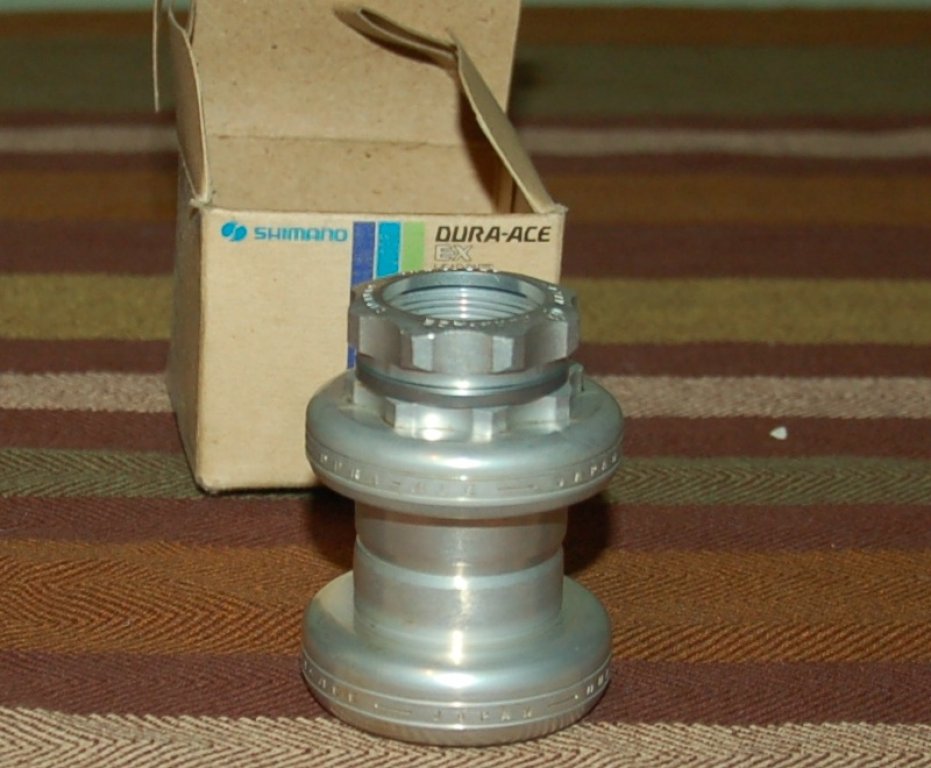
I doubt Shimano has plans of returning to the UA-110 headset, but if they do, I will be ready.
Tuesday, December 23, 2008
One on One Studio
 Inevitably, when the cycling discussion turns to which shops "do it right," One on One Studio is always mentioned. For years, I've heard about the magic going down in Minnesota and often the buzz is hitched to One on One (OoO). If you were a mountain biker in the late 80s or early 90s, then you have heard of the shop's founder, Gene Oberpriller. Gene is as much a part of early mountain bikes as Tioga's tension disk and Suntour XC PRO. Through his years in the sport, the industry, and the city of Minneapolis, Gene understands his clientele and the local cycling scene. In a word, Gene gets the importance of creating a community environment. With so much talk about the bike scene in Minneapolis, it was time for BKW to hit the road again, this time in an effort to get some One on One time.
As I stepped foot into the shop, I was greeted by the creak of the worn wooden floors and the growl of an espresso machine's milk steamer. To my right sat a row of tables and a couple sharing a bowl of soup. Upon first glance, I had to wonder: Where are the bikes?
The shop is divided into three distinct areas: the coffee and sandwich bar, the studio, and the service area. Each section acts as a stand-alone space. As I passed through the sweet aroma of the daily brew and then through the bike inventory, I landed in the service area that buzzed with activity. To my right, running the full length of the space, rested every incarnation of Bianchi's single speed MTB and to my left, was a wall of printed memorabilia and current events. Upon my arrival in the service area, new inventory was being diligently entered into the database and repairs were underway.

One on One is a curious mix of coffee shop, bike shop, ecelctic art gallery, and junkyard; a bit of a museum of useful things, if you will. In many ways, One on One is the bike room that you dream of and, to a cyclist who loves Bridgestone and its history, this shop just can't be missed. Herein lies the evidence that Gene knows a thing or two about what makes a cyclist tick: sweet machines, all the tools you could imagine, never-a-bad-cuppa espresso machine, cool art, and all the keepsakes from your years of racing. What more could a cyclist want?
A walk through OoO:
When I first entered the door, I turned around and resting above the front door is Gene's orange X0-1 from '93, the very bike Gene rode to victory at the famous Chequamegon 40. This piece of history remains outfitted with all the bells and whistles from the era: a Softride suspension stem, Shimano 737 SPDs, moustache bars, and even an orange Silca frame pump. For a rainy October day, the shop was alive with the sights and sounds of a traditional bike shop.
Light Fare
The first third of the shop is a fully functioning coffee house, complete with artwork and a menu of delicious items. The coffee is excellent, the treats fresh, and the soup is good enough that you'd be proud to call it your own. Sandwiches round out the menu and prove that One on One is good for more than replacing a broken spoke.

The Studio
Gene's studio portion of the shop displays bicycles as the works of art that they are. Featured on waterfall type racks, each model is represented only once. Here, there's no "big box" approach where the inventory is spilling out of every nook. Whenever I visit a shop where the bike display emphasizes the bicycle itself, I'm reminded of how beautifully simple the bicycle is, and how it's certainly worthy of the prime space above your fireplace. The "studio" feel of Gene's shop is the idyllic backdrop for the aesthetic beauty of a Bianchi, and whether it's the pedigree of their high-end road machines or the smooth swoop of the Bergamo's handle bars, One on One provides the right canvas for these masterpieces.

Service
The service area is located in the rear of the building, which provides those seeking service with a direct alley entrance. This area was the gem of my entire experience and I spent the majority of my time closely eyeing it's very facets: cabinets housing both old and new bike components and frames, CD collections, historic machines, and a selection of handlebars that would make a stem rattle with excitement. Among the treasures I uncovered was an old velvet lamp, a fallback to the edifice's previous life as a sizzling "massage parlor".

The Basement
Words can not do justice to describe Gene's basement. Floor to ceiling. Wall to wall. Get yourself to Minneapolis and see it for yourself.

One on One Studio is an unparalleled and unprecedented shop for the cyclist who relies on his machine for transportation, livelihood, or just plain 'ol mental wellness. With all the cycling-centric activities offered in Minneapolis, it would be easy to time your visit to catch a handful of memorable cycling events both on and off the bike, year 'round.
One on One Studio
117 Washington Ave N. - Warehouse District
Minneapolis, MN 55401
Phone: 612.371.9565
Wednesday, December 17, 2008
Ham and Swiss
 My dad is full of great stories, stories about the PROs, stories about the local cyclists and of course stories about the people who were his customers for over 30 years. One of my favorite stories centers on the old school technique that defines my father's 60+ years of cycling.
 When my dad was in his mid-sixties, he was a strong rider; riding just shy of 300 miles a week. One summer he and a group of his buddies/customers got together for a spin. Out and back, 70 miles, nothing too crazy, just a few friends on a gentlemanly cruise. At least that is how it began. As the ride rolled north and out of town the pace began to pick up. There were a number of hard efforts and the wind was blowing in, strong and consistently. Some of the greenhorns were tuned-up for the early season races and were lifting the pace above the agreed gentlemanly level, turning the screws in an effort to demonstrate their prowess.
As the group hit the half way, the greenhorns decided to stop for a quick bite and a refill of the bottles. The plan for a quick stop turned into a plan for lunch and then a table for six. There were still 35 miles to ride and a full meal at this point would be too much. As the group began to order, my dad and his best mate looked to each other and both knew there was only one way to play this.
The waiter took everyone’s orders: milkshakes, an omelette, a double cheeseburger, pancakes, and as the orders rounded the table they came to my father. Ham on white bread, a slice of Swiss, nothing else. No bacon, no lettuce, no sausage links, no strawberry milkshake. Nothing. And a water. His best mate replied with a devious smile, "I will have the same." Once the group had finished eating it was time to head back. A slow rollout as the legs began to divert the blood from the stomach and the group began to get back into the homeward effort. The group began to get playful and the efforts began to increase.
My dad sat in right behind his mate, as the tempo increased. Almost as quickly as the heavy breakfast went down, it began to come up. The riders who had eaten the breakfast fit for a king were beginning to take on a pale, greenish color in their faces. Once the green began to show, my father and his mate lifted the pace. As the pace lifted, the greenish color began to fade into a ghostly white color. One more attack was all it took for the breakfast club to scatter in search of some privacy. The greenhorns had proven they were strong; they had proven they could bring the pain. But bringing the pain is about more than steady, hard efforts. The pain is brought with brains as well as brawn.
Sunday, December 14, 2008
Joe Parkin: A Dog in a Hat

Always keep the Belgian knee warmers away from the private parts.
—Joe Parkin
So goes the inscription on my copy of Joe Parkin's memoir of racing in Belgium, "A Dog in a Hat." It's a simple truth to be sure. Some of the greatest books are built on a succession of such observations. However, it is just such an observation that stands for the very nature of Parkin's look back.
I've known Parkin for more than 10 years, since he was a pro mountain biker for Diamond Back. He spent a winter racing 'cross in my neck of the woods and we crossed paths each weekend. Arguably, one of the best images I ever shot of cyclocross was of him with his bike on his shoulder running like a looter. If I can find that shot, it will run here.
Later, he graciously shared his experience with me as a trusted talking head any time I needed a quote from a former Euro-pro for an article. I respected him because he had done Europe the hard way. To me, going to Belgium and joining a European team is tantamount to climbing Everest without oxygen. While meaning no disrespect to the riders of 7-Eleven and later Motorola and U.S. Postal, in my mind his deep-end jump had PRO style in spades.
These days, my trip to Interbike is incomplete until I catch up with Joe. What I didn't fully appreciate back when I was requesting quotes was the depth of his experience, so I was eager to read his book to find out more. I expected good, but what we've been given is much, much more.
Parkin has written an eloquent and historic volume. It is an unflinching look at pro cycling that is marked by a most mature perspective. It lacks the indignation and emotion-laden rhetoric of those who have written in judgment about doping, which is to say Parkin wrote objectively about his experience. His views are made clear, but he condemns no one; we all have our views on the subject and his incredible grace allows the reader to watch without turning the author's experience into a morality play.
The book is also funny. Parkin has a gift for analogy and comedy that could be utilized should Will Ferrell ever make a movie about bike racing. I laughed out loud as he recounted an episode during the Tour of Switzerland. A hungry bike racer has never been funnier.
And while cycling is its main concern, the book's true subject is the pursuit of a dream. Parkin chased his ambition to be a great pro cyclist and whereas most of us can scarcely fathom the incredible success Lance Armstrong enjoyed, we have all wondered what we might have achieved if we had gained the opportunity to make that jump and pursue what talent we might possess. It is the story that would likely have been the rule for each of us seeking to punch our ticket. In the very uniqueness of his story, Parkin realizes a universality that gives his recollections a resonance with any cyclist.
What marks the book is Parkin himself. Not his story, but his perspective. His acceptance informs his choices, his prose and his immersion in the culture of Belgium. Parkin applies himself with humility to Belgium, to training, to his teammates, and you hope for him, all the while knowing that there is no glorious win, no big-time contract. In anyone else's hands, such an ending would be tragic, but Parkin reminds us what real success is: the acceptance of our friends. That's the true measure of a man.
Do not miss this book.
Thursday, December 11, 2008
The Art of the Attack
 Some very well-oiled musical act was performing on the Macy's Thanksgiving Day Parade, and all I wanted to do was watch a bike race. It should be impossible to turn away from the Macy's Parade. It is America itself. The recording the act was lip-syncing to showcased their virtuosic voices in flawless time. Their movements were choreographed to the 16th note. Their appearance epitomized the style of their chosen demographic. They were very nearly perfect. I felt like I was being force-fed a Twinkie.
The announcer called them artists. Performers, maybe, but artists, never. To a boy, they were selected in auditions. They'd been taught how to sing just right, taught the choreography step-by-shimmying-step. They'd been assigned a wardrobe. The last thing any of them had written was an e-mail.
There was a time when what you heard on the radio began with a spark of inspiration in the performer. It meant an interview with the band would give you insight into the song's creation, rather than the blow-by-blow of the producer bringing them the song in the studio.
I still prefer music performed by its creator; there's an authenticity that comes when the performer is also the writer. It's a little like eating organic foods; we know it's healthy, but more naturally produced foods usually taste better, too.
I don't mind the education; we all have our teachers. And I don't mind the idea of production; imagine The Beatles without George Martin. What I object to is the foregone conclusion, which is why I'll never be at a post-Tour criterium. If the riders are there to put on a show, how about a team-time trial with some hand-slings? Give us some polish, a little Cirque du Soleil on 700c wheels.
Which is why the Classics are so great. With 40k to go, there's no saving something for tomorrow. The team directors can scream in the riders' ears all they want, but at the moment of the attack, the move is nothing short of a creation, a force of will destined to leave a mark on the race. Whether it results in the win or not is beside the point; each attack is an important, necessary part of the race, the same way a Pink Floyd song needs a David Gilmour guitar solo. The solo isn't the point of the song, but it would be incomplete without it.
Those final kilometers of the race are a crazy, improvisational progression with each attacking rider trading eights in a jazz riff: first the guitarist, then the drummer, then the pianist, the drummer again, then sax, drummer, bass, drummer and head out. When you see a rider spring from his saddle and gun it, we cheer because he has just shown his hand, it's everything he's got, who he is.
Those late-K attacks are the real deal; it's no time for a probing move. And the final, race-winning move is the grandfather of all attacks, the piece de resistance in the classic sense—the move that defines the race precisely because it results in the win. The riders themselves understand this, which is why when they describe a race as beautiful, we know it to be true: That final attack is a masterpiece.
Image courtesy John Pierce, Photosport International
Thursday, December 4, 2008
The Blue Sky Taunt
 Each year the list of things to keep you off your bike grows longer. When you're 21, you don't need much more than clean cycling clothing and food. The chores increase, the job takes more and more, the girlfriend becomes the wife, you start the pint-sized team, and pretty soon you're no longer fitting in the responsibilities around your riding, but the riding around the responsibilities.
 The structure we'd give our training gets usurped by the larger architecture of everything that's not cycling. No matter how much we'd like, we can't periodize the job or the bills. The miles take a backseat. And even when we think we'll get the miles in there's the dreaded OBE—overtaken by events—that can turn two hours of intervals into two hours of interminables.
Worse yet are those days when the time is there but the legs or heart aren't willing.
Inevitably, there comes the point in the day where we step outside and there it is: the blue sky. The key turns in the cylinder; I should be out there … riding.
Whether we get the miles or not, we're going to suffer. The sky's silent siren call holds the promise of mile after amazing mile. The longing we have for a simple turn of the crank is worse than being dropped. At least when we're dropped we're still riding. Not being out there—the lost miles—hurts worse than throwing money away. It hangs above us, the pull easing only with the darkening sky.
When I was in grade school the nuns always told us to take our sufferings and offer them up to the Lord. What God would do with my seemingly incessant childish sufferings, let alone why God might have any desire for them, I could not figure. Needless to say, I never got comfortable with the idea of offering my mental backwash to my maker, but the concept left an impression on me.
I save the suffering. There are lessons in the suffering. Those toughest moments in the rides give us our strength and the ache we feel for each missed ride is a chip we cash each time we need to dig just a little deeper.
Subscribe to:
Posts (Atom)


 Posts
Posts