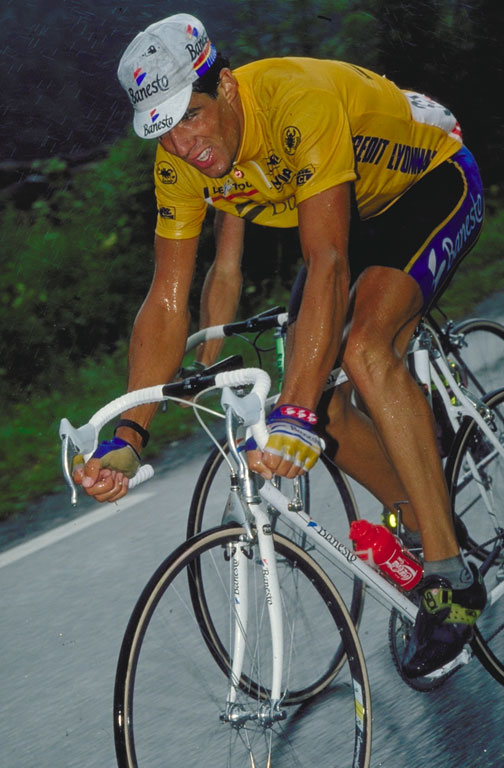
Paris Roubaix is a race steeped in tradition. Every chapter in the race's history sees common threads woven throughout, and this lays the foundation for Paris Roubaix's timeless appeal. Almost every other race in the PRO calendar has been touched by the hand of modern bicycle technologies. A look at the Tour de France reveals high-tech machines taking advantage of the most advanced technologies available to the manufacturing world—an engineer's showcase of the thinnest, lightest, and fastest—an envelope pushed so far that the UCI has a specific rule in place in an attempt to keep things safe.
br
The race's tradition extends far beyond the route, the stones, or the concrete showers, rather the tradition extends into the mindset of the riders themselves. Many understand that the race is comprised of unpredictable events and the fastest way to a win is to limit as many unknowns as possible.
A walk though the start village in Compiègne illustrates the different strategies of the teams. Some teams and riders opt for cantilever brakes, others the standard road calipers. Some go for double tape, the 23, 25, 27, 28mm tires, and suspension forks. The list of Roubaix-specific accoutrement is as long as the line at the espresso tents. However, there is one gear selection that remains almost unanimous among teams: the decision to ride "traditional wheels".

The term "traditional" is used by many of the teams to describe the traditional, 32-hole hub, three cross spoke pattern and "low profile" rim with a tubular tire glued to it. Over the years and with all the developments in wheel technology, it is fascinating that the wheel choice for Roubaix remains a "low-tech" option.
Undoubtedly, the high-tech players are in hot pursuit of a seat at the Roubaix table. Zipp, for example, has been hard at work developing a deep section carbon wheel capable of delivering all the performance characteristics against the wind, while continuing to be able to handle the stones. Most recently, the CSC team has been spotted at Flanders with a deep section, rear wheel, and a traditional front.
(BKW has spent some time speaking with the folks at Zipp; stay tuned for a future post featuring Zipp's experiences at the Classics and the future of a deep-section carbon Roubaix wheel.)For more information on the traditional wheel approach, we placed a call to BKW friend and PRO mechanic
George Noyes. As a recap, George turned wrenches for cycling's best and did his time in the trenches for 7-Eleven, Motorola, Cofidis, and Mapei. George has built enough wheels in his career to fill a stadium and included in his builds are wheels that carried the Lion himself to victory at Roubaix.
When speaking about the traditional wheel style with George, it becomes immediately evident that he remains passionate about wheel building and he respects the love and attention to detail so common among traditionally constructed wheels. Although the options for wheel building seem endless, the builds at Roubaix all seem to be alike.
A wheel for Roubaix needs to deliver overall durability, lateral stiffness, and the ability to absorb impact. George confirmed that in the years before deep section, carbon wheels, mechanics often built the wheels with lower spoke tension to give the wheel a softer ride. Today, however, George notes that riders prefer their wheels built with a higher spoke tension because most are accustomed to the ride quality of today's high tension wheels.
An interesting side note regarding the wheels for Roubaix: George recalls, the mechanics always pulled the oldest wheels first. Back in those days, the traditional wheelset was the only wheelset. The Mapei team used the oldest wheels on the truck for Roubaix and, quite simply, Roubaix would be the final ride for these wheels, prompting immediate retirement upon removal from the bike. The team's star riders would always begin Roubaix on a new set of wheels.
Here is a quick glance at the wheel builds for Johan and team:
Front WheelRim: Ambrosio Nemesis 32 hole
Hub: Shimano Dura Ace 32 hole
Spokes: Sapim or DT (Aero when available*)
Tire: Vittoria
Build: 3X with lower tension in spokes
Rear WheelRim: Ambrosio Nemesis 32 hole
Hub: Shimano Dura Ace 32 hole
Spokes: Sapim or DT (Aero then tied and soldered)
Tire: Vittoria
Build: 3X with lower tension in spokes
* Aero spokes were an expensive option and despite the Mapei budget, they were not always available to the mechanics.

Tire pressure remains as much art as science. According to George, the ideal tire pressure for the Roubaix course walks a very fine line, balancing enough pressure to keep the rider above the stones and low enough that the bike feels stable and provides shock absorption. Like cyclocross, tire pressure is considered too high if the rider doesn't frequently bounce off the rim.
The best riders have mastered the art of
riding "lightly" enough that they can run a ridiculously low pressure without puncturing. Typical pressure for the Mapei riders hovered around 5 3/4 bars (83 PSI) for the rear and a shockingly low 5 bars (72 PSI) in the front. "The lower the pressure, the more stable the bike is over the stones," notes George.
During our talks, George laughed as he recalled Museeuw's tendency to bleed out air prior to the start of Roubaix. This served as an outlet for nervous energy and the best were always pushing the envelope, seeking the lowest possible pressure. "I used to threaten to glue the valves closed so Johan could not change the pressure," says George.
The traditional wheel set-up has been a part of Roubaix's history since the first race back in 1896. Although developments in wheel design have grown exponentially in the last few years (and some are Roubaix specific), Roubaix appears to be a race where the PROs themselves fear leaving anything to chance and the fear of embracing technology comes from a traditional mindset trusting a traditional wheelset.

The wheels featured in the photos above were built by the skilled hands of George and bound for Max Van Heeswijk's Willems Veranda's Continental Team.
Photo courtesy George Noyes


 Announcing a product recall is not typically the type of info we share here at BKW, but Mavic's recall of the R-SYS front wheel is worth mentioning.
 The fall is my favorite time to try out new products. When my mileage and intensity are down it is a good deal easier to incorporate a new variable into my routines. This fall we were introduced to a number of new chamois creams.
  Paris Roubaix is a race steeped in tradition. Every chapter in the race's history sees common threads woven throughout, and this lays the foundation for Paris Roubaix's timeless appeal. Almost every other race in the PRO calendar has been touched by the hand of modern bicycle technologies. A look at the Tour de France reveals high-tech machines taking advantage of the most advanced technologies available to the manufacturing world—an engineer's showcase of the thinnest, lightest, and fastest—an envelope pushed so far that the UCI has a specific rule in place in an attempt to keep things safe.
 The term "traditional" is used by many of the teams to describe the traditional, 32-hole hub, three cross spoke pattern and "low profile" rim with a tubular tire glued to it. Over the years and with all the developments in wheel technology, it is fascinating that the wheel choice for Roubaix remains a "low-tech" option.
  Tire pressure remains as much art as science. According to George, the ideal tire pressure for the Roubaix course walks a very fine line, balancing enough pressure to keep the rider above the stones and low enough that the bike feels stable and provides shock absorption. Like cyclocross, tire pressure is considered too high if the rider doesn't frequently bounce off the rim.
  The wheels featured in the photos above were built by the skilled hands of George and bound for Max Van Heeswijk's Willems Veranda's Continental Team.
 Interbike is great way to see the latest and greatest, and any films from the gang at World Cycling Productions provides insight into the PRO peloton and the art of racing in the big leagues. Both, however, lack the depth and insight into what it means to be deep in the PRO world. Deep in the sense that you are living and breathing PRO cycling.
  Suppose for a second that you are God. Not Eddy Merckx, but God. It’s T-minus 1 hour to the Big Bang. What would you want to have happen? You’ve got the power to create anything, everything. Wouldn’t you want explore the range of your own ideas?
 We’ve just returned from our first opportunity to ride Shimano’s leap into the great unknown. Unknown because no one really knows how the market will accept it. In a down market fewer $5000+ bikes are leaving shops and there remains some resistance to bikes that can cost upwards of $10,000 even among those who aren’t hurting.
 I’m going to split the difference on this one: We don’t need Di2 the way we need more efficient cars. The Segway was an invention that hasn’t made the world more interesting. On the other hand, I wouldn’t want to still be stuck on Nuovo Record. Great as it is, I’m glad for integrated brake and shift levers—now there’s an answer to a question someone asked.
 I found the sound of the shifter, when far from the halls of the Sands Convention Center (and the crowds milling around the bike), to be strangely amusing. It’s not terribly unlike the sound of some brake pads on a carbon fiber rim, the difference being that the sound doesn’t last long (very short for the rear derailleur and just twice as long for front derailleur upshifts) or change in pitch.
 The textured lever hoods feel like a rubber diamond file pattern. I’m not sure I’d want to ride on these for more than an hour or two with no gloves. That said, grip won’t ever be a problem on these.
 One thing I barely had time to experiment with was middle finger braking from the drops while downshifting with my index finger, or braking from the hoods and sliding my middle finger around to the downshift button. I’ve always appreciated how you could brake and downshift the rear at the same time with Dura-Ace, and I don’t particularly want to give that up.

 Posts
Posts