 The Monuments of cycling are indeed just that—monuments—to the fallen soldiers of the World Wars. The Monument events are composed of five races. They are: Milan-San Remo, the Tour of Flanders, Paris-Roubaix, Liege-Bastogne-Liege and the Tour of Lombardy. What unites these events is their history. Each harkens back to a time before the World Wars. The youngest of the five monuments, the Tour of Flanders, took place for the first time in 1913, a year before World War I began.
In my experience as a photographer, both Paris-Roubaix and Liege-Bastogne-Liege are indeed war memorials. The roads that are used are protected under local council laws; these are the same roads used by the young soldiers of the First World War.

Roubaix is known as "l'Enfer du Nord" which translates to "The Hell of the North." That expression came from the soldiers who were posted there. The rough farm tracks and cobbled lanes that are used are what was left after the bombing in the First World War.
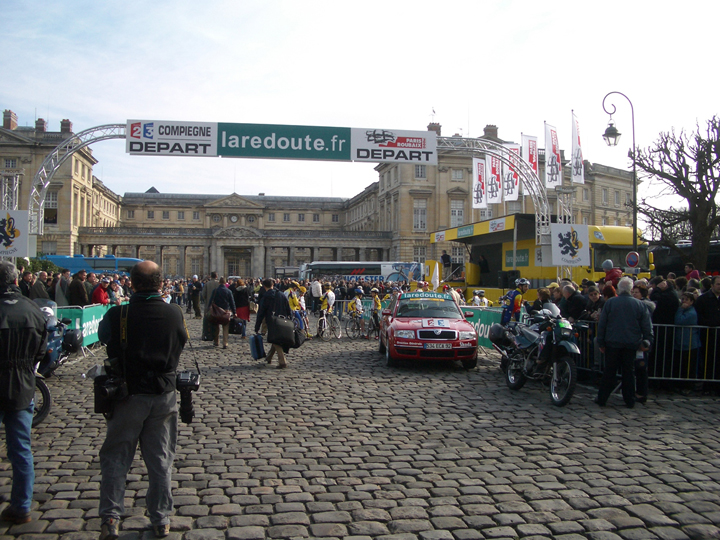
After the war it was decided to dedicate the race to the fallen soldiers of the Great War. The race starts in Compiègne, 60km north of Paris where the French made the Germans sign the WWI Armistice.
The first Armistice of Compiègne was signed 11 November, 1918 at 11:00 am. It was held in the forest outside Compiègne because there were two sets of railway tracks and the trees would hide the events from the air. The two tracks were approximately 50 meters apart.

The Second Armistice at Compiègne was signed on 22 June, 1940 at 6:50 pm near Compiègne, in the department of Oise, between Nazi Germany and France. Following the decisive German victory in the Battle of France (10 May-21 June, 1940), it established a German occupation zone in Northern France that encompassed all English Channel and Atlantic Ocean ports and left the remainder "free" to be governed by the French. This second armistice signaled only the cessation of war between the French and the Germans—Hitler continued declaring war on the rest of Europe from the same railway carriage.

Adolf Hitler deliberately chose Compiègne Forest and the same rail car as the site to sign the armistice with France due to its symbolic role as the site of the 1918 Armistice with Germany that signaled the end of World War I with a German defeat. Satisfied with his revenge, Hitler then declared war on the rest of Europe, and had the prestigious rail carriage taken by road to Berlin and ceremoniously destroyed.

There is now a replica rail carriage and museum on the site, which is well worth the visit. It is just a few kilometers from the Royal Palace (the site of the sign-in and start for Paris-Roubaix) on the south side of Compiègne; it is well signposted.

Paris-Roubaix traverses the Arenberg Forest—itself a war memorial dedicated on consecrated ground. It is forbidden to drive through this area except when Paris-Roubaix is run, and even then only the race can go through the Arenberg—all spectators must walk in. The forest of Compiègne is funded by public donation; when a child is born, or when a soldier or family member dies, the relatives buy a tree which is planted in memoriam. A friend of mine, Christelle Cocquempot, formerly of La Redoute, (sponsors of Paris-Roubaix) has a tree planted in her name. It was donated by her parents when she was born.
Liege-Bastogne-Liege is the same; the race route passes many battlefields. Tanks—Panzer in German—are among the few survivors from WWII. The race passes through Houfalize, but it’s hardly recognizable compared to the town that stood before the war. It’s so sad what the Germans did to the town, and then what the Allies did to oust the German occupation. It was worse in many ways than Dresden. There is a German Panzer in the town square to this day.

The total German advance was stopped, hundreds of tanks, simply halted by a handful of British and American small tanks, which were really no match for the superior German armor. There are several small Sherman (USA) and Churchill (GB) tanks set in concrete also as memorials to the struggle that saw the tide of war turn against the Germans. We know this turning point as the Battle of the Bulge; victory was snared from the jaws of seemingly sure defeat.
The Allied soldiers forced the Germans to run out of petrol by attacking the fuel dump. There is a small memorial by the roadside commemorating the event. I'm sure not a single rider has ever noticed.
Special thanks to John Pierce of Photosport International for his essay and photos.




 Posts


