Tuesday, May 15, 2007

At All Cost

Is it any wonder that WADA is going after Floyd Landis tooth and nail? Consider a possible situation in the abstract: A cyclist tests positive. Following an evaluation of testing procedure, auditors find that procedures were skipped, machines mis-calibrated and rights violated. A reasonable person could be forgiven for coming to the conclusion that the resulting black eye to WADA would undermine public confidence to such a degree that there would be little respect for the findings. Kinda like how we view intelligence reports of WMDs by the CIA in say, oh, any Middle Eastern nation. Put another way, if WADA were to lose such a case, many people would—rightly or wrongly—come to the conclusion that the organization lacked the ability to catch the real dopers and would mistrust any result as yet another false-positive. Ever heard of the boy who cried wolf? WADA knows lost cases undermine credibility, which is why the organization believes it can’t afford to lose a single doping case. But such a strategy is counterproductive.

Whether you believe Landis’ Wiki-defense or not, the truth is none of us really know if he doped. He makes a compelling case for his innocence, but we really don’t know. And the truth is there are cyclists who are innocent of doping but whose names have been forever tarnished. Take the case of hapless Danilo Hondo.

Danilo Hondo has been shown to have had such a low concentration of Caphedon in his body that it not only didn’t affect his performance but it was most probably too tiny an amount to be deliberately administered. Put another way, he didn’t mistakenly take too little, such as might happen in an error concerning order of magnitude where someone takes 10mcg instead of 10mg. This guy didn’t intend to dope and didn’t benefit from the presence of the drug in his system.

He received the same penalty as a rider who doped in order to win as a result of a policy known as “strict liability.” It dictates a zero-tolerance environment (adopted to give the appearance of being tough on dopers) in which any stray compound found in a pro’s system results in a penalty.

Another hypothetical: Suppose you are driving down the street in a 35 mph zone. You approach a construction site that is soon to be a new school. You miss the new 25 mph speed limit sign and an officer notices continued rate of speed. He pulls you over. In the United States, the officer has leeway to give you a warning instead of a ticket for what would otherwise still be a minor infraction. In the world of WADA, you don’t drive for two years. Period.

Some people may think that the “strict liability” standard is reasonable. It is not. American jurisprudence is built on the idea that intent is significant when a crime is committed. The courts in America hold that the penalty for striking a pedestrian with your car should be different if you never saw the pedestrian and did so only accidentally than if the pedestrian was your former boss and you waited outside of work for the chance to run him down and subsequently backed over him before fleeing to Tahiti. Grading crimes according to severity helps to give the public the perception that outcomes are fair. Stealing a pack of gum is not the same as stealing a car, no?

In the Landis case the defense has accused WADA and the lab at Chatenay-Malabry of poor record keeping, shoddy lab work, changing and erasing computer data and refusing to let their representatives attend a procedure WADA’s own rules grant. An American prosecutor accused of such action could wind up disbarred.

WADA tested B-samples of Landis’s urine to which the A-sample was clean—this is a clear violation of its own procedure. Logically, if the A-sample was clean, the B-sample cannot be tainted, provided the lab did the work correctly in the first place. If the lab didn’t do the work correctly then it shouldn’t be permitted to perform any further testing until an audit of its procedures and equipment has been performed. In finding a B-sample positive when an A-sample is negative, only one thing has been proven: The lab is not performing its science consistently. Repetition of results is one of the most basic standards of science and any lab that can’t manage that isn’t much of a lab.

Because the administrative process is not transparent and WADA and USADA seem engaged in a win-at-all-costs ideology, we are unlikely ever to learn the real truth to whether or not Floyd Landis doped at the Tour de France. If we cannot be certain that the outcome was justly based on fact, then there are four victims: The first is Landis; he deserves an outcome based on the truth, whether he doped or not. The second is WADA; if we are not convinced justice was served, we will not trust it is fulfilling its mission. The third is the sport itself, which is losing fans due to the general mistrust for all cyclists in the PRO peloton. And the final victim, of course, is us; if we are not convinced WADA is pursuing its mission competently and that the athletes are clean, we are robbed enjoyment of our favorite sport.

This entry was written out of love, frustration and a desire to see some clean, healthy competition in the PRO peloton. Thanks to Padraig for this great contribution.


Photo Courtesy: www.theage.com

Monday, May 14, 2007

PRO is PROGRAM GO!

Deep section carbon wheels deliver amazing performance and define the modern PRO style, however, some also come with an annoyance: a clicking sound that seems to present itself over rough surfaces. I have traced this noise to the valve and the resonating click, which comes from the valve snapping against the carbon valve hole. I tried numberous times to address this sound, both on my Reynolds Stratus tubulars and my Cosmic Carbone PROs, but it was the delicate touch of a PRO mechanic that provided the ultimate solution. At the 2005 Interbike show, I was treated to an up-close and personal view of Thor Hushovd's Look 585, fresh from his 2005 season. Among the PROness, I noticed one small, but amazingly simple PRO mechanic fix for my valve problem: electrical tape. A single piece of electrical tape is placed perpendicularly with the rim; it's pierced by the valve and adhered to either side of it.

From that moment on, this is how I roll.

Thursday, May 10, 2007

Wednesday, May 9, 2007

Omerta

The term “Omerta” is known as the silence of the mob. Don’t rat. Until recently, the term has only been used in connection with the mafia. Recently, though, Omerta has come to be identified with cycling’s collective silence on the problem of doping. Attached to the term in its original usage was an odd sense of honor and integrity, a captain-goes-down-with-the-ship mentality. If caught, you defended yourself without implicating anyone else and if convicted, you did your time … quietly. Plea deals were for drunks, not gangsters.

Ladies and Gentlemen, we present Ivan Basso, Mister “I was only researching the possibility of doping, but didn’t actually dope just yet.” If you want to be an honorable louse, this is how it is done. He will tell nothing of what he might know, only of his involvement in what he says was yet to become doping. Lest anyone think his admission is a step in the right direction, this is Omerta at its classic best. He has copped to only what they have irrefutable proof of. This isn't a light bulb in the darkness but a flashlight pointed the wrong way--after the Giro victory was on the books.

Should anyone think his admission will help turn the tide against doping, what he has done, in fact, is teach his brethren a sort of low-impact plea. His statements were to full disclosure what the Toyota Prius is to a carbon footprint. Frankly, his behavior stands in stark contrast to what are now the typical displays of mob togetherness as seen in trials such as John Gotti's and on the Sopranos: "If I'm going, you're going too." Should we actually praise Basso for his amazing integrity? Not if we want a dope-free sport.

This entry was written out of love, frustration and a desire to see some clean, healthy competition in the PRO peloton. Thanks to Padraig for this great contribution.

Monday, May 7, 2007

The Tan

Summer is almost here, and with it comes white tape, high mileage weeks, and insane tan lines. A cyclist's tan line is something that almost defies explanation to a non-cyclist: a striped leg created by shorts and socks, a pale hand punctuated by a dark circle, or the white area in front of your ear from the helmet strap, where literally "the sun don't shine". To a non-cyclist, the tan lines that are so common to us, warrant a double-take.

For me, the tan line is a mark of accomplishment, a sign of your dedication to logging miles on your machine, and a statement that shouts: "despite all of my other commitments, I still find time to ride my damn bike!"

Each season I place the bottom of my shorts on the same tan line I randomly established over 20 years ago. Back-to-back seasons have etched a tan line so defined that it would require a two month, Speedo-induced holiday on the world's finest beach to simply undo it. In the off-season, I barely lose my tan line despite the dark and cold winter and the etched line serves as a great reminder of seasons' past.

Forget tracking the KMs, the quality of your season can simply be measured by your tan.

Monday, April 30, 2007

Campagnolo Dust Covers

Back in January 2007, I visited NYC and had a chance to ride with an old friend who had relocated to the Big Apple. We enjoyed a couple of hours spinning around Central Park and catching up on old times, sprinting the climbs and enjoying the down hill sections.

As our ride came to a close and we rested in the warm January sun, I noticed a small but subtle detail on his machine.

This detail (above) could only come from one shop: Conrad's in NYC. If you have never been to this small shop in Tudor City, it's an absolute must. The crew at Conrad's has been building exquisite machines with the utmost attention to detail for decades and they have undeniably perfected the art of the finish. Whether it's the immaculate, tape-less finish of the handle bar tape (think bar tape on the tops without the traditional electrical tape) or this little gem, Conrad's does it right. The next time you make it to NYC, drop in and see for yourself the level of detail inside the shop.

After seeing this beautiful trick I had to emulate it. The rubber caps are provided with the brakes, and I think they are intended to keep the barrel adjuster connected to the brake in transit. I simply punched a small hole in it and threaded the cable through before attaching the cable at the anchor point. From the dust collected on the cap you can see that this trick provides some protection to the integrity of the cable and housing.

When in NYC, visit:

Conrad's
25 Tudor City Place
NY, NY 10017
212.697.6966

Wednesday, April 25, 2007

The Horse’s Mouth

There’s nothing like hearing it from the horse’s mouth. The horse, in this instance, is Specialized. What we’re hearing is the story on Tom Boonen’s bike—in greater detail. Let’s start with the basics. According to Specialized media honch Nic Sims, Specialized tries to get new teams on their bikes as early as possible so that riders can adjust to new geometry but due to contracts the earliest Quick-Step could be on bikes was at the January training camp, when each rider was immediately sized and presented with a stock bicycle. Boonen was even presented with both the 58 and 61-cm bikes. He chose the 58 because it gave him the desired difference in height between saddle and bar. When the initial fit wasn’t to his liking, Specialized’s next step was to offer him a selection of custom-made stems. Sims says that making custom stems is something the manufacturer can do at the in-house frame shop in Morgan Hill. A 14cm stem didn’t do the job. A custom frame was the only answer.

As you’ve heard, Boonen’s bike is 13mm longer than his old Tarmac SL. What that means is that he is riding a custom bike made from the E5 material with a top tube that is 13mm longer than the top tube on the 58cm Tarmac. Naturally, with a longer top tube a few other changes to frame dimensions must be made (such as the introduction of a longer downtube) and while those frame dimensions are different from an existing Tarmac size, Sims stressed that the custom frame produced for Boonen bears the same handling geometry as a Tarmac, though the longer top tube does result in an obviously longer wheelbase. More than a few people have criticized Specialized for not immediately making Tom-tom a custom carbon-fiber rig immediately. Sims says making a custom carbon-fiber frame wasn’t considered a practical first response due to the time it takes to re-tool . The designers at Specialized wanted to get the fit right before committing resources to a custom carbon frame and the best way to do that was to go through the design iteration phase in aluminum. Thanks to their careful work, the design team nailed the fit on their first try and Boonen was satisfied. He has since signed off on the design and Specialized sent those drawings overseas for the construction of the mold. That’s right, the construction of the mold. Sims says a hand lay-up of carbon fiber would not have met their stringent quality control or performance requirements.

The net result is this: In May, Boonen will take possession of a custom-fabricated Tarmac SL. Only this one won’t be quite so, uh, SL. His frame will weigh approximately 100 grams more than a comparable frame due to an extra wrap of carbon fiber on the frame to make his bike just a little stiffer. And before you criticize the stiffness of a Tarmac, bear in mind that this frame is being built for a guy who has little trouble delivering 1500 watts in a sprint. As a point of pride Sims pointed out that Mario Cipollini’s custom E5 Tarmac used, in fact, the mountain bike tube set. Said Sims, “That bike was so stiff it was uncomfortable for most people to ride.”

Asked how expensive it was to build a mold for a bike meant solely for Tom Boonen and Sims responded, “I don’t know, but really expensive. We’ve already invested a million dollars in this team, so it was worthwhile.” When asked if the company wasn't exposing itself to potential negative coverage by having two very public teams using its frames—surely any accidents or problems vaguely linked to the product could have a negative impact, Sims responded, “Quite to the contrary, there is no better testbed than the Pro-Tour and we count on our sponsored riders to give us as much feedback as is possible. As a result of feedback from riders like Tom Boonen and Bettini we are already making changes to our saddles and wheels. Tom Boonen didn't fit our Tarmac frame so we had an aluminum frame built which we are using as a template for a carbon frame that we’ll be able to deliver to him in May. All of this feedback and the tweaking that results helps us make better bikes for every rider.”

It would be unfair to typify the Specialized road bike line as anything but high-performance, that the bikes aren’t actually of quality befitting a professional. Sims points out that for the rest of the team riders in Gerolsteiner and Quick-Step, a production size has worked fine, but because these guys ride thousands of kilometers per year, any change in fit can be greeted with dismay. Sims said, “Most of these guys notice a 2mm change the average person may never notice.” Giovanni Lombardi called a bike that featured a bar position 2mm higher and 3mm longer a “f#$&ing chopper.” As a result, he cautioned, “When you’ve got someone of the caliber of Bettini or Boonen—World Champions—you do whatever is necessary to keep them winning.”

Another big thanks to Padraig for digging deep and compiling this report for BKW.


Photo Courtesy: Specialized Bicycles

Saturday, April 21, 2007

April Showers

Spring has made its intentions known. At least to the meteor-ilogical community. Winter slammed its cold body into us during the first week of January and like any good hip-check its presence is still being felt. After a Spring like two weeks, temps have struggled to climb above 1 degrees C forcing any riding to take place with multiple layers and between snow and rain showers. The trainer, my basement and the cycling re-runs I have been watching are now retired, I refuse to revisit them. To add insult to injury, the cold weather has also brought 4 cm of the white stuff. In April!! But, the forecast for next week is improving, bringing some April like temps. For these conditions, the full fender machine is the best choice. Fit some 25Cs and a blinky light and come high-water or flooding the riding will be done outside.

Lars Michelson's winter rig courtesy of Speedplay Pedals

Wednesday, April 18, 2007

Steel is Real

There is a low frequency vibe spreading out across the cycling world; silently building its momentum. Like a seismograph reading the first stages of an earthquake, web 2.0 is broadcasting loud and clear. If you listen carefully you can hear the resonance; the carbon bubble has just popped. I know this may sound radical and even senseless, but from inside the eye, it is still and calm and the vibe of the people has been sent. You've heard it here first. Sure, carbon will stick around and companies will continue to throw millions into R&D, the materials will continue to improve, they will get lighter, stiffer and stronger. Yet, the cycling world is preparing to ask for more.

The next frontier (ironically enough) will be steel. Steel delivers a fantastic ride, with beautifully sculpted lugs, perfect brazing materials and temperatures, and buttery smooth tig-welded joints. Steel is predictable in its ride, comfortable over the roughest of roads and delivers a message from the BB directly into your body which unmistakably conveys that you are one with your machine. Now if that was not enough, throw in a beautiful paint job. Most of the bikes on the road have a natural carbon finish with the only color being the occasional decal. Steel is truly an artisan's product, with decades of perfected building techniques.

If steel were a new material, recently engineered to be the ideal replacement material for bicycle frames, it would be the hottest thing to hit the industry. Comfortable, resilient, serviceable, light and delivers a ride like no other. In fact the ride is so wonderful that exotic materials often try to imitate.

Steel is real.

Photo Courtesy: Seven Cycles

Tuesday, April 17, 2007

Cage Match

Pro Racers vs. Bike Construction vs. Sponsorship

It used to be the relationship between a bicycle sponsor for a professional cycling team and the bikes the team rode was limited to decals, paint, and cash. In the 1980s, when 7-Eleven first entered the Euro peloton, they rode frames made by Serotta. Later, team management signed Huffy as a sponsor, but Serotta continued to supply the frames, which was a lot like putting a Ford decal on a Ferrari. 7-Eleven was riding what was easily one of the best bikes available.

By the late 1990s, it was becoming apparent that with the entry of big American bike manufacturers into the European peloton that the face of sponsorship was shifting for obvious economic reasons. Cannondale, Specialized, and Trek all sponsored Division 1 teams, thanks to their marketing muscle, but there was no way a boutique builder like Serotta or Seven Cycles could hope to compete for a frame sponsor position.

Given the diverse shapes of current composite frames, there is little opportunity to try to put a Ford decal on a Ferrari. The bikes are pretty readily recognized. What’s more is that in the quest for ever lighter frames, design has shifted away from traditional lugged designs. That shift doesn’t portend well for ideal fit. Most frames are using a variation on monocoque construction that require use of a specific mold for each size. In round numbers, each mold for each size runs roughly $100k. Such high tooling expenses really don’t permit custom frame sizes. They do, however, permit companies to construct the lightest and stiffest frames ever made.

We’re not going to engage in a pissing contest about whose bike is stiffest or whose is lightest. Suffice it to say that production bikes tend to be the very lightest and stiffest on the market.

Which is what brings us to Tom Boonen. The Specialized Tarmac can not be made in a custom format. Forgetting pro teams for a moment, consumers today are forced to make a choice. When purchasing a frame, you must either choose perfect fit and idealized geometry from such manufacturers as Serotta, Seven, Hampsten, Parlee, or Calfee or you can pick something that is incredibly light and stiff, such as Specialized, Trek, Cannondale, Kestrel, Scott, Giant, or Time. Of these, Parlee is one of the few bikes that is bridging the gap between custom sizing and light, stiff performance.

Back to Boonen. We haven’t been given much info about his back trouble. He wasn’t complaining of back trouble last year when he was riding a Time. Somehow, the switch from Time to Specialized aggravated his back—whether or not there was a previous injury to his back we’ll never really know, and it isn't important. He said his back hurt and that’s enough. As for what we’ve been told of the new, “custom” bike, all we’ve heard is that it is 13mm longer. Umm, hello, is this thing on? Thirteen millimeters where, exactly? Is that 13mm in the wheelbase? In the top tube? In the front center? Just in the chainstays? Could it be that Tom Terrific was just too big for Special Ed’s biggest frame?

We shouldn’t conclude that just because Boonen was moved to an aluminum frame that it is stiffer than his old rig. Frankly, to make a bike stiffer than the Tarmac would require the addition of steel rebar. And not all aluminum frames are unduly stiff. From Alans and Guerciottis to the Cannondale CAAD7, there are plenty of aluminum frames no one would confuse with unduly stiff. In fact, the Alan is the most popular cyclocross bike of all time precisely because it isn’t stiff.

What can be said of aluminum is that it tends to transmit a great deal more shock and vibration to the rider than frames made from other materials. Part of this is just the nature of the material and the rest is due to the fact that virtually no one—save tandem manufacturer Santana—uses double-butted tubing, which was proven to dampen shock long before the Beatles hit the airwaves.

The Tarmac comes in a 61cm size that features a 60cm top tube. That’s long. Boonen is 6’ 3”. Without knowing other details it's difficult to guess what his preferred frame size is, but he could easily require a 61 or 62cm-long top tube. It’s true that his new, aluminum bike looks like the Langster fixie, but as the largest size of that bike comes with a 58.8cm top tube, there’s little chance the folks with Special Eyes elected to saddle the Monster from Mol with an even shorter top tube. Given that his bike has an assortment of braze-ons that permit him to stop (other than on-contact) and shift gears and one can safely take the release at its word. The bike is custom. The real question is if his sponsor is examining the possibility of offering a new, larger size in the Tarmac. It would be suicide to commission a $100-grand mold just for Boonen; the question is, how many 6’ 3” customers might there be?

The age of the aluminum bicycle in professional racing ran roughly concurrent with the Clinton administration. It started and ended about the same time, was no less exuberant, though ultimately felt just as uncomfortable. To put a rider of Boonen’s caliber on a soda can today does seem criminal, but the upshot has one curious effect.

For years boutique builders have staked their reputations on the importance of ideal bicycle fit. Led by Serotta, custom builders (or as Richard Sachs likes to say, “made to measure”) have almost always claimed fit is more important than materials. Companies such as Seven Cycles include very specific instructions on the fitting process for potential clients. Boom-Boom Boonen’s increased comfort on an aluminum rig suggests that a custom-fitted bicycle is more important than the frame material used. When faced with the option of riding a not-so-optimally sized but terribly advanced carbon fiber bike and a custom -itted but low-tech aluminum ride, former World Champion Tom Boonen seems to be happier on the tailored pop can.

If Ben Serotta, Rob Vandermark, and Richard Sachs start talking smack about production bikes, cut ‘em some slack.

BKW long time friend and powerhouse cyclist Padraig sent us this piece as a follow-up to the original Boonen piece posted to BKW.

Photo courtesy: cyclingnews.com

Saturday, April 14, 2007

En Forårsdag i Helvede


It's Francesco Moser, with his disticntive style, his still aerodynamic position on the bicycle is an imposing sight of almost effortless rotary action. - A Sunday in Hell

Now, I love Phil and Paul, but this is completely and utterly the finest description ever spoken in a cycling film. I owe my buddy PF a debt of gratitude for introducing me to A Sunday in Hell. He knows all the lines and can provide you with real time palmares information on all the riders in the film. No one knows 1960-2007 racing statistics like PF.

Friday, April 13, 2007

2006 PR - April 9th, 2006 Part Two


12:17
RR: 4 riders with 10 seconds at 62.5K...

12:21
RR: riders have 12 sec at 65K...

12:23
RR: riders have :17... the day's break...?

12:29
RR: :20


Time for a banana Clif for me, Sean eats a second sandwich and a powerbar.

12:39
RR: :35

CSC van and car come by... Sean's old mates... Crazy Nor man jumps out and starts chatting Croc race and, "Man Sean, you putting on pounds? (incredibly taking the piss), croc yeah, but there is a new one (get this) 58 stages, 7000K, Paris south thru Pyrenees...I'll get you the info, only 30 people first one to see how it goes... Three months with all the traveling..."

Wicked. That would be the life.

Sean now doing disco/video shite... Did I mention they are following us? Yeah, the Texas crew in a van behind... He gives the American audience "you have been informed" per Roubaix, but I think we are still stupid


1:00
RR: avg speed is 47kph so far... They are 3K from Triosville, pave sect #27 (ah, the memories...) Can hear, now see helis... Sean and the boys start walking our sect 24... I take watch of the car from the drivers seat - still nodda on teli...

1:17
Q-step car just rolled up in my rear view, across the street...sneaky bastards...just spoke to Joe, they were at the first sections, 4 riders, then 3, the GH looking strong and fast in the bunch...


RR: peloton at 3:35

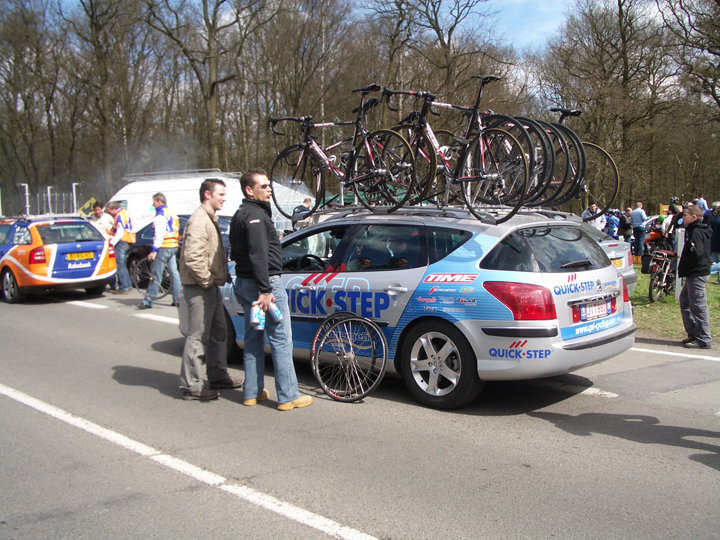
Getting out to check out the Q-step machines... Whatev
Forgot to mention the caravan came thru around 12:45... Got a yellow mussette for someone...
Helis have gone some time ago, but just came back briefly...
Did I mention is gorgeous weather? Amazing out. Sunny and crispy.

1:27
4 guys blast thru our pave #24, Rabo, T-M, Agrub, Ill-Bal..


1:30
3 guys thru... Agrub, Liqui, Eski, then a G-stein a few back

1:31
The main bunch with tommy on front - there is some shouting... See Roger, Gusav, Noval...

1:34 Sean runs back with the boys, he has a trek computer that bounced right to him... Young guy gave a bottle to GH...

Johan is now on the radio...2K to 2K sec, give GH food, missed feed, 4:20 to the break, stay together, move up...

They are :15 ahead of schedule...

Race Teli is now on... And I'm signing off, can't type and not get sick at the speed, corners, etc...

Until next section. Ta.

1:57
arrive at sec #19... Boonen is not in PT jersey, in WC. The rules have changes since they made Oscar wear it at MSR last year, thankfully...

2:01
Sean and boys take off up the road. I watch le car.


2:08
RR: Peloton has hit #21...

2:18
4 leaders come by... Ill-bal guy takes a digger on the 180 slopping corner in town... Helis are overhead... Lone G-steiner, Euski... Then the bunch on their heels... Big group... A cofidis rider eats it like the i-b rider

We are out - Sean, "Vamoose...

Benjamin and Mika were off the back but now we hear Johan congrat them on getting back... He asks GH how he is feeling... JB feels the team should rock it up before the next sec#18 and get the group smaller on that section, too big, so go fast on #18 - before the forest... #17... ARENBURG- "too many things can happen, we must take responsibility... Make sure we have all we need, food, drink... Ben and Mika will take up the pace at the front...

It's 2:30.

2:36
JB: come on a boys, come on, keep fighting... Everyone to the front, the next one is the forest...

2:38
Stuck in traffic, American guy chats with Sean, "driven this before?, blah blah... Sean is like yeah, few times... Comes back a few moments later, oh, you're Sean Yates!? I'm sorry and tries to shake his hand, Sean not so much and says no reason to be sorry, probably don't recognize me with all my grey hair, the man says yeah, ah, mistake again...what was I saying just earlier? We're stupid? Yeah... You've been informed ...

When Sean gets back in the car I apoligize for my country and he and the boys have a big laugh...

2:45
The forest... All hell breaks loose... Boonen to the front, Hoste is there, Cancellera is there, they catch the break as they leave the forest at 2:50... 15 or so guys... 3 discos... Boonen has a combo PT and WC jersey and not sure of his team mates in the front...

Out.

3:05
We are at sector #14...Sean: have some of these (Lu choc sticks) before I eat them all - good for the form...

The gruppe of 17 has :35... We think Boonen is without a teammate and Q-step has 5 guys on the front of the bunch working hard which solidiflies this notion a bit - GH has Hoste and Gusev... "Very good boys, crackles thru from JB... Come on a Roger... Stay with the Quicksteppers...:50... Eat and drink, stay in reserve, talk to one another...eat and drink! Eat and drink!

It's 3:14.

JB: stay in reserve, we do not have to do all the work (CSC has two)...1:00... Really slowing down back here... There is Van Petegem, etc. There is interest here, just keep it rolling, eat and drink... Roger, very good, watch van bon and pozzato here... 1:30 now... 2.5K cobbles, 500m road, 2.5K cobbles, don't work too hard there is a lot of interest in the group...

It's 3:20, I hear the helis...

JB: after the second sector, we have a feed zone...

Young guy just came back... 14 guys roll thru... The race is on. Nav guy says he fcuking tired, I'm running the next one... Sean got a bottle to Leif, Gusev got 2... JB: no need to be nervous boys, feed zone next.

3:27

4:02
FUCKSAKE!!! George's stem just broke! And he crashed wickedly...He is out.

Boonen has attacked with V-P and Cancell... No merci as Sean said

Shite.

I'm out.

4:22
We are at the end of sector 6 now, bummin, George was so strong and with two team mates...but Hoste, Gusev and Flecha caught on after a few minutes, so a group of 7 on the front. H+G will not work much in the group, time to bluff... JB: in flemish, Leif you can win it if you believe it...Everything is in Belgian at this point on the radio...

Sean thinks it was not the stem but the steerer that broke like Hammond at Gent and ToG... Ouch for Trek.

4:40
...after being almost dropped, the Goose takes off on sector 5, Cancellera is the only one who can stay with him!!!! No Booner!

They have :20!

They only have the Cd'L left...

Cancellera goes!

Gusev is dropped!

JB: Leif you must attack!

Leif goes!

Leif drops Boonen!

V-P joins Leif!

Goose is waiting for them... Boonen has blown!!!

Cancellera has :30 over the three chasers... He is flying, he is timetrialing to the win if he can hold on...

:33 with 10K to go!... Shite!

4:52...

5:19...Cancellara wins!

Hoste takes 2nd in the sprint from Van Petegem... Goose is 4th... Boonen easily takes next sprint for 5th...

Damn. Bad luck for GH again...

He would have beaten Cancel in the sprint I think ...

Next year...Next up, TdF. I hope he didn't hurt his shoulder...

Out.

5:26...UPDATE!

Officials rule that because Hoste, V-P and Gusev went around train posts
that were down before the train came they are disqualified! Boonen gets 2nd
now!

Fucking hell...

All the luck and more.


Brunyeel begins the task of debriefing Paul Sherwin and the rest of the press on George's crash and the decision to DQ Gusev and Leif.

Final Results

1 Fabian Cancellara (Swi) Team CSC 6.07.54 (42.239 km/h)
2 Tom Boonen (Bel) Quick Step-Innergetic 1.49
3 Alessandro Ballan (Ita) Lampre-Fondital
4 Juan Antonio Flecha (Spa) Rabobank
5 Bernhard Eisel (Aut) Française des Jeux 3.25
6 Steffen Wesemann (Swi) T-Mobile Team 5.35
7 Frédéric Guesdon (Fra) Française des Jeux 6.31
8 Bert Roesems (Bel) Davitamon-Lotto 6.44
9 Christophe Mengin (Fra) Française des Jeux
10 Staf Scheirlinckx (Bel) Cofidis, le Credit par Telephone 6.45

Photo courtesy JS

Originally posted November 27, 2006 - 7:01 AM

Wednesday, April 11, 2007

PRO is PROGRAM GO!


Photo Courtesy: Flickr

2006 PR - Saturday April 8th, 2006


On April 8th final preperations were under way. The teams used the mild weather and sun to pre-ride the course and take advantage of their last opportunity to learn the nuances of the pavé. Team mechanics began final equipment selections based on the anticipated weather forecast. JS and company headed out into the French countryside to ride the course and test both themselves and their equipment against the individual stones that make up the famous pavé of PR. JS shot this quick note back to HQ.

Cobbles were epic yesterday!!!

We left just after 9 and got to Troisville about 11am (got the GPS finally working – we forgot our maps back home, rush job) and found the route and hit the first section (#27 ) after about only 1K of smooth road to warm up... Ouch. Then it was on. Finding smooth bits, stopped at the third section to see a big concrete war bunker, the Phonak team caught us just after, then Joe flatted, we did a few more sections and the Disco boys rolled up, rode with them a bit and I chatted with George. We lost them when Joe had to stop and tighten his now loose cleats; we did a few more sections, tried to find a road back but after :30 failed minutes we just doubled back - adding two more sections we hadn't done, (#19 and #20)... I then flatted, and at this point we're about 3:30 into the ride and Joe, the current runner training for a 50K run, is bonky a bit after a few more sections and we finally find an open patisserie/market and maul 4 apple crisps, 4 bunny chews and 2 tiny cokes... Recharged we hit the last 4 sections, only I flat again on the rear (had only a 12g cartridge) and Joe gives me his 23mm wheel to continue and (hopefully) bring the car back. Note to self - have 3 tubes and 3 cartridges EACH - and 25mm tires - which I had. I knew the teams rode 25’s from RTP/Postal but Joe decided to go with just 23s, 2mm makes a difference amazingly enough...*

So, I end up blasting back, a little over 5 hours riding - almost 6 with punctures, pedal issue and food stop... We think about 130K, about 30.7K in cobble for me: 7 sections out, 8 return. And who says no climbing?, we did over 3000 feet of rolling vert today..

We wanted to do another set in the middle today, Arenburg to Cysong, and double back again ... But ended up sleeping hard and late, 9, and chatted with the teams a bit this morning, then rolled into town and the first 25K out and back of the race route from Compeigne here – so an excuse to come back for sure. I really really loved the cobbles – being more from MTB and riding ‘cross really helped me over Joe big time I think (he said it was 10X worse than he expected, not smooth like the ones in A’dam)... You just have to go fast and roll, stay loose... As you may know. But some sections were bone shakers for sure, can’t image wet. Ouch.

(*Cancellara rode 27s on his Cervelo)


Flat number 2 on Pavé Sector 26
Viesly at Quiévy, France

Photo courtesy JS

Originally posted on November 27, 2006, 10:00 AM

Tuesday, April 10, 2007

PRO is PROGRAM GO!

2007 Paris Roubaix

The 2007 Edition of Paris Roubaix is gonna have to be utterly and completely "off the chain" if it's gonna hold a candle to last year's race. Hincapie's broken steerer, FC's solo hardman break, the train incident, resulting DQ, and, of course Boonen's fifth place and eventual second.

BKW friend and Marathon MTB man JS was lucky enough to witness PR from the backseat of Yates' Disco team car. But don't think it was all fun and games back there. JS was pounding away on the Crackberry, firing minute-by-minute reports detailing the action as it unfolded with the help of race radio and Yates' inside commentary. It was from his transcript and insane behind-the-scenes photos that BKW was born. In the days leading up to PR, I will be reposting these entries; I feel they greatly capture the action as it happened. I've seen the race countless times (thanks to the crappy winter we had here) and, even a year later, my palms get sweaty as I read them. Enjoy.

Monday, April 9, 2007

Going Tactical

A good friend of mine is an officer in the LAPD, the po-po as they are affectionately known on the street. The LAPD have a term they use to describe a situation when something escalates to a physical level: "going tactical" or going hands-on. I love this term and I have morphed it into a term I use in cycling. At this early point in the season, there are some really strong riders bringing the pain on the group rides. Many already have logged thousands of miles, opting to ride outdoors and indoors or in some cases, locations reached by flying off to warmer temps. I was not able to get away this year and, in turn, have looked to running as a way to beat the cabin fever. My fitness at this point in the season is a couple notches below the fast guys and, as a result, I have be smart on the group rides. I have to "go tactical". Saturday's ride was an awesome, Belgian-style, slug fest. All the hammers were in attendance, the skies were grey and the rain had just moved out; things were reminiscant of the 1998 Valkenburg Worlds. Yesterday, the mind was stronger than the body. I made every effort to stay near the front of the ride and I paid for it. Just shy of the halfway point, I was ejected from the group and the resulting alone time gave me the opportunity to reflect on my mistakes.

Sunday was a different story. The sun was shining, temps were a record 15+ degrees C, and there was a sneaky southwest wind blowing in Belgian-style. On the way out, I played my hand close to the vest, I repeated the words of Brunyeel at the 2006 PR: "Eat, drink and stay in reserve". At the end of the ride, my body was tired, but not as tired as my mind. Trying to ride smartly takes a lot out of you─hiding from the wind, picking the good wheels, and doing everything to avoid opening a gap. When the fitness is good, I can take more risks, ride with less upstairs, and more from the legs (robot style). I think I need to take some time off work and schedule some super-secret training miles at an undisclosed location in an effort to bring the fitness as fast as possible. Maybe this season's late start will allow me to make it through to cross season with my body and mind remaining fresh through the fall season? Or maybe I will just be burnt out and get my ass kicked again like last year.

My father, who has spent his life in the cycling world, would say "it is only April!" But the new training styles seem to neglect the time off and, if I want to hang with the group I so love, then I need to follow suit. Right?

Saturday, April 7, 2007

2007 Ronde van Vlaanderen

Paris Roubaix is a tough race because of the threat weather poses. Already tough roads are made almost impassable by the slightest bit of rain, earning PR its name: Hell of the North. The Ronde van Vlaanderen (RvV) is equally as tough, but rather than the course surface, it's the hills and distance that make the RvV so brutal.

This year's Ronde takes place on April 8, 2007, and new for the 91st edition is the decision to eliminate the Koppenberg. Again. Following a makeover that produced a kinder, gentler Koppenberg, it was re-introduced to the fans' delight. Race organizer Win van Herreweghe explained that the surface shows broad gaps between the cobbles making the climb dangerous especially in wet conditions. Win commented, "We do not want to allow non-sporting elements to rule how the race unfolds."


So, there it is: the Koppenberg is too dangerous. I find it ironic that the Giro organizers purposely seek out progressively harder routes for each edition of the Giro, but the orgranizers of the RvV are seeking to make the route in essence easier. All in the name of sport? The condition of the cobbles never seem to cause concern among the PR organizers. I would argue they relish in the fact that PR is the toughest, nastiest one-day race. Undoubtedly, last year's RvV was epic, especially when many of the race favorites were forced to run the Koppenberg following a pile up. It was a "Flanders of old" in my opinion.

The 2007 Ronde will include 18 climbs, one more than 2006, and will feature the new climb Eikenmolen, which is a 610m hill with an average gradient of 5.9 percent. Organizers feel that the new climb and frequency of climbs in the last 80 KMs will be enough to insure a good race. I remember the disappointment from fans when the Koppenberg was on hiatus for its makeover, at least that omission was in order to preserve it for future races. This year's decision is different: Could it be curtains for good for the Koppenberg? I guess we will have to wait and see.


Photo of RvV courtesy Graham Watson

Originally posted on December 24, 2006

Friday, April 6, 2007

True to Form

There's little that can compare to the feeling of being "bike fit".
(No, this is not a nod to the black art of body positioning.) Instead, "Bike Fit" is a term I use to describe a level of fitness your body reaches after 4,800 KMs or so. This level is different for everybody. For riders who are forced to face the changing seasons, this fitness usually arrives in late June or early July. Once the body has had a chance to adjust to miles in the saddle and you have put in the mandatory 1,600 KMs in the small chain ring or preferably on a fixed gear bike, your body begins to morph into a a cyclist's body. Higher cadences are possible, regardless of the gear you are trying to turn. While riding with a group, you're able to soft pedal and time your pedal stroke in a way that requires no brakes (no matter how squirrelly your riding buddies are). The feeling becomes intoxicating and allows you to reach a level of fluidity. Seth, from Zonebaby, wrote an article describing this type of feeling. His thoughts center more on the messenger vibe than the straight-up road cyclist, but this sensation is the same in any form of the cycling discipline.

The sensation that strikes me most when I reach "bike-fit" mode is how my position on the bike seems to change. By this I mean, my machine becomes as stable or responsive as I want it to be. The way my body sits on top of the machine changes, too. The top tube feels shorter, the bars seem higher, and the seat feels lower. The muscles in my legs, lower back, upper back, and neck are all working together and functioning in a fluid, supple way. It is this type of fitness that allows the true PROs to descend mountain passes at 95 kph, while drinking from a bidon.

It seems funny to reflect on this fitness in April, but I'm beginning to log the miles and I am looking forward to reaching fitness. But like I mentioned in my article Hunkering Down, part of the fun that comes with the fitness is the work required to get there.

In season's past, I begin to feel this form come on in July, just as the summer temps begin to soar and the group rides are at their fastest.

Until then...

Photo courtesy cyclingnews.com

Wednesday, April 4, 2007

When You Race Against Me, You Race for Second Place

After winning the 2006 Tour of Flanders, Tom Boonen was interviewed by Paul Sherwin and asked if Team Discovery made a mistake by not sending Hincapie, because Boonen was "always going to beat Hoste" in the sprint. To this, Tom calmly and confidently stated, "Ah……and Hincapie, too. That's the problem with me; when you race against me, you race for second place."

The confidence the young Belgian exudes is overwhelmingly straight forward—not cocky—and stated in a very matter-of-fact manner. As an outsider looking in, Boonen seems less flamboyant than the likes of some other former sprinting specialists like the Lion King in the late 90's. Boonen is young, Boonen is successful, and Boonen is a champion. So, when a champion begins complaining about his machine, you would think as the frame manufacturer, you would listen... or would you?

Let's go through the chronology of the Boonen back problem news as it hit this 2007 season:

March 19: After dropping out of the last stage in Paris-Nice, a release is posted on Cyclingnews.com about Boonen having back problems and is working with a chiropractor to ease the pain. The release links the back pain to the FACT (pun intended) that Boonen had swtiched bicycle brands from Time 2006 to Specialized in 2007.

March 25: Boonen takes 3rd at MSR and talk continues to center on the bike Boonen is riding. In the post MSR wrap up, Boonen is quoted by saying that he, "feels like I'm 85 years old" at the end of the race which he again complained of ailing back pains. The release posted on CN today talks about how Specialized will be making Boonen a custom bicycle to help re-position him to help manage the back pain.

March 26: Just one day after MSR, and the release about Boonen feeling like a crippled old man, CN releases news that Boonen will ride a custom Specialized rig. The release was very quick to point out in the opening sentence that the rider "who has had back problems for 4 years" will be riding a custom rig. The release goes on to pinpoint the specific race--Gent Wevelgem from 2003--where Boonen crashed into a cameraman. Said Director Sportif for Quick Step Fitte Peeters, "It remains a delicate issue, but we have it under control."

March 28: In the 62nd edition of the Belgian spring classic Dwars door Vlaanderen, Boonen takes a commanding win after pipping O'Grady at the line. In an overt gesture, Boonen crosses the line and immediately points to his new machine, implying that the machine "is the thing" and that he is "Specialized." In the post-DDV race coverage, the details to the new machine are released; Boonen's new machine is 13mm longer. There is no talk of material or other dimensions, but some images from DDV show that the machine is clearly an Aluminum beast. Boonen wins the race, and comments that, "I am very content but especially I am obviously reassured on my condition and on the state of my back. The form is there."

So all is well in the Kingdom of Belgium, yes? As a Belge-phile who wants to believe that Boonen is all better and that he is set for the Ronde, I am much more skeptical and in the ubiquitous words of the Belgian common folk, "yes, but it is not possible."

Let's think about the series of events that happened in March. March 19 Boonen's back issue is leaked/released/made known to the public. Only 6 days later after MSR, it seems as if the angle in which the story was present could be viewed as too damaging . This must have been very troublesome for the Big S. They immediately release the idea of a new custom bike being built for TB. What we don't know is when the bike was being made. By March 26th press time, we have to believe that Specialized was already making a bike for Boonen, shipping it to Europe, building it, and then delivering it to him. The short lead time, however, points to the bike absolutely being produced quickly, and in a "one-off" fashion: AKA: Aluminum, not carbon.

AN ALUMINUM BIKE? For a ride complaining of BACK PAIN? This coming from a company who just wants to talk about the "FACTS" (Specialized's acronym for their carbon system: Functional Advanced Carbon Technology) about ZERTZ, about Roubaix-tested comfort? When you look at Boonen's new machine up close, and specifically the shape of the seat tube, it looks very similar to the all aluminum track model they call the Langster.

While the logic of "timeliness, responding to the problem, and presenting the ride with a tangible solution" makes some sense, I think it was absolutely irresponsible of Specialized to put Boonen on an Aluminum bike. It seems way more self-serving (provide a "solution" to the problem; respond to the media news by making a "custom" bike) to quiet the news, than an actual solution that will benefit Boonen. While this behavior is not new, it certainly is a sublte comment that even a World Champion, and possible the finest rider in the current PRO peleton, is still a pawn for the sponsors gain, or in this case, the sponsors reputation. Boonen complains of back issues, the news leaks to the press, he complains some more and does not win MSR, is given a bike that could conceivably increase his back pain, and all is well as he wins Dwar and points to his bike during his victory salute. (The pointing was no accident; it had to have been a directive). Specialized wipes their "S" hands clean, Boonen is back on top, and it's all because of the new shiny custom bike.

But the story is not over. The biggest event in the World of Belgium is yet to come. So, too, is the race that Specialized based a model line after. And it still remains to be seen if Boonen's back will hold. I'm guessing that that what looks like an all Aluminum bike is not helping the situation. While we wait for the results, as the Ronde approaches, we can't help but feel sorry for Boonen. He is clearly in some physical pain, and you would think that a sponsor would make responsible decisions and solutions that better the rider first. But, in my opinion, it looks as if he is just another pawn in the game of bicycle sponsorship. While most of this article focuses on suspicions and secondary sources (Is the new machine really Aluminum; is Boonen really hurting as badly as he says), I pose this request to Specialized: We want to know the FACTS.

BKW is fortunate to have recieved this piece from our good friend Neals who knows a thing or two about pulling a whippah and tweaking a machine to maximize the cycling experience.

Photo Courtesy: Specialized Bicycles, cyclingnews.com

Tuesday, April 3, 2007

1994 Paris-Roubaix

1994 provided cycling fans with one of the most epic PRs in history.
Heavy March rains saturated the fields surrounding the famed cobbles and washed axle-deep mud onto the course. A light rain on race day gave insult to injury and secured this edition's place in the history books. The hardest of hardmen, Andrei Tchmil, proved his mettle by securing the win. Additionally, 1994 was the year that many teams opted to run mountain bike-like suspensions systems, which included Tchmil's Rock Shox Paris Roubaix SL, a short travel, front suspension fork based on the Mag 21.

Monday, April 2, 2007

Code of the Road

Over the years, I have developed some funny habits that I follow to a T throughout the cycling season. Some of these habits began as humorous coincidences and others follow the standard code of the road. Growing up in a cycling household meant that I learned much of my discipline from my father who in turn learned from a long list of PROfessional cyclists. Some of these practices seem funny and dated but I also know from my years spent in the cycling industry that often these practices have solved nagging issues for many cyclists. Here is a sampling ranging from humorous to bizarre:

Never expose your knees in temperatures below 21 degrees C.

In colder, wet weather, the muscles and ligaments require the additional protection to prevent injury and keep the blood circulating. In essence, lubricating the knee. (This, of course, is counterintuitive to the entire BKW philosophy. But hey, I am far from a PRO and plan to ride my bicycle for another 60 years.)

No white bar tape before Memorial Day or after Labor Day.

This rule came about out of my love for the peak season ride. Now I love the cold, rain, and wind of the Spring, and nothing spells HARDMAN like braving these conditions, but there is something so basic and pleasurable about the peak summer months. The Tour in July, Vuelta in September. These rides take place in primarily beautiful weather, basking the riders in a warm glow. Often all the PRO teams are sporting the white tape in these months. Therefore, in an effort to protect my mind's snapshot of summer racing, the white is reserved for the warm months.

Early season development on a fixed gear.
A cyclist should spend the first 1600 kms of the season pedaling a fixed gear machine. This period helps develop the ability to spin a larger gear with greater fluidity, blessing the rider with the ultimate skill, a skill the French refer to as supplesse, or "suppleness". A rider begins with a lower gear combination, working up slowly every 500 kms, progressively building in gear size.

Cleanliness: Keep on it. This is a tough subject to address because the areas covered are tres personal. I'll be as candid as possible: Bacteria is bad, anyway you slice it. Wash your shorts, wash your ass; chamois time is clammy time. I have spoken to none to few about saddle sores and discomfort while riding. A couple great pairs of shorts are the first remedy followed by a disciplined approach to caring for them and you. Make all efforts to relieve yourself (read #2) before your ride. Follow this with a shower, a light layer of chamois cream (or Noxzema if you are truly an OG), and a clean pair of shorts. Rotate your shorts and wash after every ride. When you finish a ride, get out of your shorts. There is nothing PRO about sitting around in a wet chamois for hours on end, even if you're drinking a sweet espresso on a warm day. Happy cyclist, happy backside, and when forced to sit on your wheel, fellow cyclists will thank you.

Tire label at the valve.
Here is another simple but often overlooked practice. When installing a tire, line up the valve with the label on the tire. One, it makes things look PRO and two, when you have a flat, it makes identifying the source of the puncture in the tire easier. Find the hole in the tube and then locate the corresponding area in the tire. this allows for identification for the cause of your flat, staple, glass, tack or pinch flat. Wha-LA!

Sharing a water bottle: No Bueno. Never, ever, share a water bottle. As the season wears on and the warmer months take over, the heat goes up and so does liquid consumption. Concurrently, with more miles and intensity, the body's immunity begins to settle into a weakened state. This is the reason so many PROs are susceptible to colds and stomach bugs. Well, I guess the stomach bug can also be related to doping issues but let's stay on the positive. So as a rule, no matter how thirsty I may be, I never share a water bottle. I don't need to catch a cold or a stomach bug from one of my teammates. Plan ahead, bring enough water, and always be alert to sources for clean water and a bottle refill.

Drink Hot Tea. Following a ride in less than ideal conditions, immediately hit the warm shower, change into dry gear, and then enjoy a cup of hot tea. The tea helps your body warm from the inside, which will equip you to stay comfortable all day.

Tune it up. By April 1, I like to have all of my gear for the coming season dialed in. This means tires are new, cables and housing is replaced, and a new chain and cogs are fitted. I go a bit overboard and use the time to tweak the machine, I replace the bottom bracket, check, and clean all bearings and reapply grease and Anti-Seize to all threaded surfaces.

Some of these items may be helpful and some funny, but many of them govern my cycling life. As time goes on, some of these tips seem dated. Time changes the practice of cycling and this is not better evidenced than by the CONI suggestion to sport a cabbage leaf under your hairnet to keep your body's temp regulated. I'm grateful to have learned much of what I know from my father; he's been a great mentor and leader in this sport. Even as I begin to ride more and he begins to ride less, I'm always amazed at the wisdom and insight he poses. His advice centers on the simple and often overlooked, something that comes from age and experience, something I hope to be gaining every day I ride and follow my own code of the road.

Saturday, March 31, 2007

2006 Paris Roubaix Finish

The final thirty minutes of the 2006 Paris Roubaix.

Part One

Part Two

Part Three

Thursday, March 29, 2007

The Selection

I saw this photo on Cyclingnews.com and I immediately noticed this was a three-horse race. All the players are present: Shimano, Campagnolo, and SRAM. There are many ways to look at this image and the representation of the different component groups. In the photo, Shimano leads, just like their production numbers or the number of bikes sold in the world equipped with Shimano. Just behind sits Campy, trailing Shimano in sale's numbers and company size. And the truly impressive aspect of this image is that in its first year of PRO sponsorship, SRAM is hot on the heels of the two giants. I remember a time not long ago when everyone in the industry doubted whether it was possible for a small company to challenge the Shimano. I guess there were a few dedicated individuals who felt differently.

Photo courtesy: cyclingnews.com

Wednesday, March 28, 2007

Sunday, March 25, 2007

1998 World Road Championship

There have been pivitol moments in my life as a cycling fan, many of which have moved me to another level.

One such moment came in 1998 at the World Road Championships in Valkenburg, Netherlands. The October weather was more akin to early Spring, the day brought cold temps and a light but steady rain. The Belgians seemed to have the power to secure a win. Van Petegem, Ludo Dierickxsens, and the hardest of hardmen, Ukrainian-born, Belgium-nationalized rider, Andrei Tchmil, each lined up in an effort to secure a win for Belgium. But it was not to be.

The magic of this day runs deep. The weather was crap, 1993 World Champion and recently cancer-free Lance Armstong was attempting a return to the PRO peleton, and an unknown Swiss rider Oscar Camenzind came from the shadows to win the sport's highest honor...the rainbow stripes. But the true thrill of this day was not recognized until the December 1998 issue of Cycle Sport arrived at my door. (You have to keep in mind, in the U.S., cycling was not the sport it was in 2000-2005 and race info or results were normally delayed for months.) I didn't have a computer at the time so jumping over to cyclingnews.com was about as simple as performing my own dental work. I always waited for the new issue of CS with total anticipation, it took me roughly 30 days to completely wear out the pages from reading and re-reading each page. I still study the images like a jeweler inspects a rare gem (minus the squinty-eye and monocular).

The photos were insane! The coverage of the race was amazing and the riders all seemed 3-D, dirty, tired, and clearly in pain. The 1998 edition gave us the famous, dirty-faced Lance giving the 50 yard stare from beneath his Lone Star Giro, it yielded what I consider to be the best image of BKWs ever taken. Andrei Tchmil, fully glazed, sporting a hairnet, nervously awaiting the start of the race from the dry, warm comforts of the team tent. The images are burned into my memory banks, when I sport BKW. I see this image, when I ride in the rain I see LA's fierce stare and when I think of cycling's greatest prize, the rainbow stripes, I picture this race.

World Championship Podium
1. Oskar Camenzind
2. Peter Van Petegem
3. Michele Bartoli

Photo Courtesy: Graham Watson, Phil O'Connor

Saturday, March 24, 2007

Tuesday, March 20, 2007

Monday, March 19, 2007

Lights Out

"Lights Out" describes the sensation when a rider shut downs in the last kms of a race. But what about a mechanic? Mechanics can go lights out and the resulting work is expensive and dangerous. I don't want to focus on the dangerous because that's no fun. Instead, let's focus on the funny side of things. In the early nineties, while I was working in a shop in So Cal, we received a Judy SL prototype that had a sexy press-fit crown with an aluminum steerer tube. The fork lowers were a bright yellow, excuse me, Judy Yellow. This beauty weighed all of 2.8 pounds. Measure twice, cut once. In this case, the mechanic measured the head tube twice but did it sans stem, sans spacers, and whalah...proto fork with a steerer tube that was all of 3 inches long. Ooops. I am sure there are others out there with equally funny stories of trashing expensive gear all because of a little oversight, a little, "lights out" action. So, maybe you cross threaded a BB in that sweet, soft, aluminum BB shell and trashed the frame, or you clamped a seat tube in a work stand only to give it the Park pinch, or totaled a $300 handlebar with a little too much elbow grease on the allen key. Please, share your tales and although it was tragic then, we can all laugh now.

Sunday, March 18, 2007

Tuesday, March 13, 2007

Qoleum Embrocation HOT

Spring is here. The Belgium Classics have begun and the weather this time of year is always a mixed bag. I purchased some new embrocation made in Belgium by a company called Qoleum. In March and April, the weather between sign-in and the final kilometers can go from -1 to 14 ºC wet or dry. These conditions are serious BKW conditions. All last season, I rocked the Freddy's Wet and Cold (amazing stuff, by the way), but since I had read good reviews of the Oleum, I had to give it a try. To follow are some thoughts on the Qoleum HOT:

Today's conditions: Overcast, mild, 4 ºC, no wind

The Qoleum is made from a 100% vegan base and goes on like wall paper paste: thick and gooey. Once it's rubbed into the skin, it disappears nicely, leaving a dull BKW sheen (good for the cyclist who wants all the protection of BKW without the added "too Euro for you" look). The Qoleum went on and stayed on for the entire ride. Like all exceptional equipment, it went unnoticed during the ride and it wasn't until I arrived in the warmth of my house that the burn set in. It took me a few seconds to realize what was going on and, in addition to the smoke coming from my knees and lower legs, I actually started to feel a bit of heat building in my core. Once I got into the shower I really felt the heat; in fact, I was wincing in pain as I tried to wash this stuff off. I had to turn down the heat of the shower and even break out the liquid dishwashing detergent. Man, that shit is hot and stubborn. I would recommend it if you are looking for the perfect linniment for an insanely cold cross race where you have a 45-60 minute exposure to the cold. But if you are looking for something for the spring or fall, Qoleum Hot is simply too hot..it's the chinese pepper you accidently left in your scoop of friend rice! If you're out on a group ride or putting in the solo training miles and it is cold enough for the Qoleum Hot you might consider some leg warmers or tights.

Overall Heat Rating - Insane
Euro Style Rating - Low, due to the dull sheen
Smell - Minty, PRO as hell
Durability - Extremely high, even dangerously high, this stuff sticks like glue


The weather will only get warmer, so stay tuned for some reviews of other BKW products including Sportsbalm, Freddy's Choice, and Greyhound Juice.

Monday, March 12, 2007

Saturday, March 10, 2007

Vittoria Open Pave EVO CG

I've always been a fan of Vittoria's tubular tires. They remain the classic tub, with countless victories in the PRO peloton. When it comes to tubulars, I don't ride anything else. But when it came to Vittoria's clincher options, I was less devoted. There are so many great clinchers out there. Michelin and Continental first come to mind with Michelin being the only clincher tire to ever win Paris Roubaix.

At the end of the 90s, tubulars had given way to clinchers as the tire of choice among serious cyclists as materials and construction methods meant a clincher could ride almost as well as a tubular but without the headaches associated with gluing and regluing. Tire companies were mastering the use of Kevlar or Aramid and the results were to the benefit of cyclists everywhere. Finally, we could all have a durable tire that didn't ride like a cheap garden hose. It was during this period that Vittoria introduced the "Open Tubular" concept. In short, Vittoria took their highly coveted tubular tire and rather than sewing an inner tube into the tire, they finished the ends of the casings with a Kevlar bead essentially creating an "open tubular". Hence the name. This technology quickly made Vittoria's Open Tubulars the best riding clincher. With one exception: the tires would literally fall apart after roughly 1,600 kms. I remember Vittoria would boast about their dual compound tires, identified by their dual color treads. A harder compound for the center gave it a faster rolling surface and intended to prolong the tread life. The shoulders had a softer compound that gave the tire added grip in the corners. It was this marriage of tire material that also proved to be the weak link as tires would literally separate at the joint. To add insult to injury, the compounds used were susceptible to cuts, so customers would return tires to the shop, essentially in pieces and with deep cuts everywhere.

In 2001, I bought a set of Open Corsa CX tires. The ride was simply wonderful and they were more durable than the Vittorias of previous generations. Relative to other tires they wore out quickly, but the wear took place over roughly 1,500 miles. Vittoria tires are no longer made in Italy, they are now produced in Thailand, gone are the quality issues of old; engineered out through material development and manufacturing methods. The resulting tire exhibits the ride of an expensive tubular but with all the ease of a clincher.

In 2005, I switched to Vittoria almost exclusively for summer and winter riding discovering the Pave EVO CG tires. One glance at any Spring Classic and it is tough to miss the distinctive green and black of the Pave. The PROs opt for the tubular configuration, taking full advantage of reduced pinch flats and the ability to continue riding on a flat tire. For me, I opted for the clincher version of the tire. (Even with all of the snow plow damage from the winter, my riding conditions aren't even close to the rough cobbles of Northern France).

Vittoria's 290 threads per inch (TPI) give the tire an extremely flexible casing, delivering a supple ride while giving the tire an ability to conform and roll over objects. This is especially desirable when the road surface is rough or when the tire is at an angle during cornering. After all, a comfortable tire provides the rider with a cushion and, on a three-hour ride; this makes a big difference in performance. Even in 2005 the Vittorias wore quickly. The treads remain more susceptible to cutting than, say, a Conti 4000, and the softer compound tends to wear out in half the time of a Michelin PRO Race. However, I am willing to deal with these issues because the ride quality is simply unparalleled. The essence of a great tire is comfort and grip and the Open Pave EVO CG has both. In spades. The tread pattern on the Pave is diamond-shaped; similar to the old CG tubular (hence the use CG in the name), but slightly more aggressive and the rubber is softer than the standard Open PRO CG tire. The use of a softer material allows the tread to remain flexible in colder temps and gives the tire bite in the wet.


The Pave comes in one size, 24mm, and it runs true to size. The wonderful thing about this tire is that even though the rubber used is softer than a standard road tire and the profile is 1mm wider than a traditional "road" tire, the Pave rides like a race day tire. Back in 2007, Vittoria offered up an all-black version of the Pave EVO CG, giving it a subtler, stealthier look. I am a fan of the all-black tire; it hides asphalt scuffs and road marks.

So, how do they perform? The Pave is fast, light, and grippy as hell in the rough or wet conditions. The best part about the tire comes during the first October ride when the summer tires are removed and replaced by the Pave. The 24mm profile and the softer compound give the tire a smooth, comfortable ride. For two tires I paid $115. Not a bad deal given that the tires ride so well and are going on their third winter season. If you have never ridden Vittoria tires, I would highly recommend trying them and the Pave in particular. The ride is fantastic in the 115 psi range and really come alive on rough surfaces in the 100 psi range. The Paves look PRO as hell and will deliver some sweet miles.

Thursday, March 8, 2007

PRO is PROGRAM GO!

ZD at CBS goes hugely Euro for the 2007 season.

Friday, February 23, 2007

Mavic Cosmic Carbone Ultimate

Mavic is poised to release a new Carbone for 2007. PRO teams rode these wheels discreetly as prototypes in the 2006 TDF and they have finally made it to prime time. The Saunier Duval team has been riding them in Mallorca and ROAD's very own Neil Brown had an opportunity to ride them. The wheels have a very "Lightweight" look to them, complete with tall hub flanges and kevlar spokes. If the wheels come with the optional Mavic Potection Program, Lightweight may have some issues at hand.

Check out this site: Roues Artisanales and all the crazy PRO action on it. There is also a piece on the 2008 Shimano group complete with updated pics of the electronic group.

Photo Courtesy: Roues Artisanales

Friday, February 16, 2007

Wednesday, February 14, 2007

Saturday, February 3, 2007

A Statement From The Landis Camp

Flanked by team members of a different kind, Landis is again the underdog. He stands tall despite the odds, accusations, and challenges, and not to mention, the mountains, of beaurocracy. Tactically, I feel Floyd has played his cards well, relying on science and training data to support his claims. Undoubtedly, Floyd has a long way to go. My hope is the process moves quickly enough so Floyd has another shot at professional cycling.

Read more about Floyd's Power Training Camp and check out the sweet custom Pegoretti he's riding at Road Magazine. Thanks to Neil for the use of his photo.